Showing posts with label comedy. Show all posts

Friday, 30 May 2014

FILM REVIEW: A MILLION WAYS TO DIE IN THE WEST

Anna (Charlize Theron) and Albert (Seth McFarlane) in A Million Ways to Die in the West.

Gun damn our history

By Ed Rampell

Meanwhile, back at the ranch:
 
For those who enjoy genre spoofs and gross out humor, Seth MacFarlane’s A Million Ways to Die in the West serves up a heaping pile of humor with a million mirthful movie moments. Others who prefer their comedy to be cerebral and refined, rather than raucous, may wish to hang up their spurs and sit this dizzy dosey doe out. While those minus any sense of humor at all should just stay at the old homestead, instead.
 
Although your critic also enjoys the dry wit of a Cole Porter or Noel Coward lyric, he belongs in the former camp and laughed (what’s left of) his head off. Around 40 years ago, when Mel Brooks unleashed Blazing Saddles on an unsuspecting public, scenes such as Mongo’s horse-punching and the campfire farting vignette were considered to be irreverent and outré. In a similar way, in our post-Brooks world, MacFarlane pushes the envelope of our more jaded 2014 sensibilities with scatological humor and jokes in bad taste (and that surely taste badly) that have rarely been seen on the big screen in a major Hollywood production. In terms of standards per onscreen behavior, this is MacFarlane’s Family Guy and American Dad animated TV series on cinematic steroids, raising crudity to the level of high art. (Although A Million Ways to Die in the West holds back when it comes to breasts and female genitalia, which Sarah Silverman as the droll hooker Ruth merely describes, whereas male genitalia is more graphically exposed. Why the shyness, Seth?)
 
As the auteur of A Million Ways to Die in the West (MacFarlane directed, co-wrote and stars -- although, unlike Brooks, he did not punch the holes in the sides of the celluloid), he takes deadly aim at the genre conventions of the Western. Indeed, for our continent’s indigenous peoples, the Westward ho! expansion from sea to not so shining seas was nothing short of a cataclysmic, genocidal catastrophe that is now also turning into an ecological nightmare. Underlying MacFarlane’s critique of the Western lies an awareness of this unadorned history.
 
Like numerous John Ford classics, part of A Million Ways to Die in the West was shot on location in Monument Valley. Mac the Knife satirically deconstructs and debunks cowboy clichés, stressing that in stark contrast to silver screen hagiography, the Wild West was an awful place to find one’s self in. There is an especially delicious joke about the “selfishness” of American Natives, and at the very end (warning -- don’t leave before all the end credits have rolled!) whitey gets his comeuppance for caricaturing newly free slaves at a county fair.
 
Like many a genre spoof A Million Ways to Die in the West walks a fine line in between making fun of the Western’s archetypes and tried and true traits. Sometimes the mockery devolves into becoming the very thing which the iconoclastic artiste has been poking fun at. Such may be the case vis-à-vis the relationship between Albert (MacFarlane) and Anna (Charlize Theron, who may be the horse opera’s most fetching, winsome gunslinger since Jane Fonda rode the purple sage in 1965’s similarly hilarious Cat Ballou, which co-starred Oscar winning Lee Marvin and what is, hoofs down, screendom’s most screamingly funny steed ever).
 
A Million Ways to Die in the West is at its satirical best when it lampoons the mythos of gunslinging. As gunman Clinch Leatherwood, Liam Neeson does a good job of harpooning not only the long-ballyhooed celluloid stereotype of the High Noon-type triggerman, but of the action hero/tough guy roles the actor, who once played Oskar Schindler has been, lamentably, cast in of late. Although it’s hard to assess the psychological impact of and quantify the romanticizing of gunplay in our culture, who knows how many Westerns that pathetic, demented mass murderer in Santa Barbara and others of his shooting spree ilk have seen since birth?
 
MacFarlane’s screen romp is also at its finest when depicting Native Americans, Hollywood’s perennial “noble savages.” A Million Ways to Die in the West portrays them as savage, then as noble -- enlightened heathens who, through psychedelics. lead Albert on an Oz-like trip wherein he attains clarity, if not a taste of enlightenment. Wes Studi -- who played Magua in 1992’s The Last of the Mohicans, the title character in 1992’s Geronimo: An American Legend and the Na'vi chief in 2009’s Avatar -- is, as usual, great, portraying Cochise. For my wampum, Studi steals the show (his niece DeLanna Studi is also a gifted thespian).
 
Neil Patrick Harris also co-stars as Foy, a cross between a city slicker and gunslinger who competes with Albert for the affections of Louise (played by Amanda Seyfried, who, unlike Theron, is not, for some reason, very attractive here). Look for comic Bill Maher in a clever cameo.
 
As for the plot of the movie, it’s very secondary to the boundless laughs for those tickled pink by sheep penises, hats full of excrement and the like. In other words, your humble scribe loved it and recommends it to those for whom this type of rude, crude comedy is their cup of piss -- uh, I mean “tea.” To paraphrase Horace Greeley, it made this reviewer say: “Go Seth, young man!”        


Friday, 7 March 2014

FILM REVIEW: THE GRAND BUDAPEST HOTEL

M. Gustave (Ralph Fiennes) in The Grand Budapest Hotel.
Concierge can(dan)dy

By John Esther

Inspired by the writings of Stefan Zweig -- a middlebrow, middle class, Viennese, classically liberal author who was very popular throughout many parts of Europe and the U.S. in the 1920s and 1930s — the latest film by Wes Anderson (The Royal Tenenbaums; Moonrise Kingdom) follows the adventures of a cunning(lingus-t) concierge named M. Gustave (Ralph Fiennes) and his loyal sidekick, Zero (Tony Revolori), who must outwit robbers, a psychopath killer, and the law as 1930s Europe begins to fall prey to a sinister form of government.

The film opens up in a charming manner with Author (Tom Wilkinson) giving us viewers a lecture on where authors draw his or her source materials. To prove his point, he tells us the story about when he was a younger author (now played by Jude Law) and his encounter with Mr. Moustafa (F. Murray Abraham) during the final days of the titular hotel.

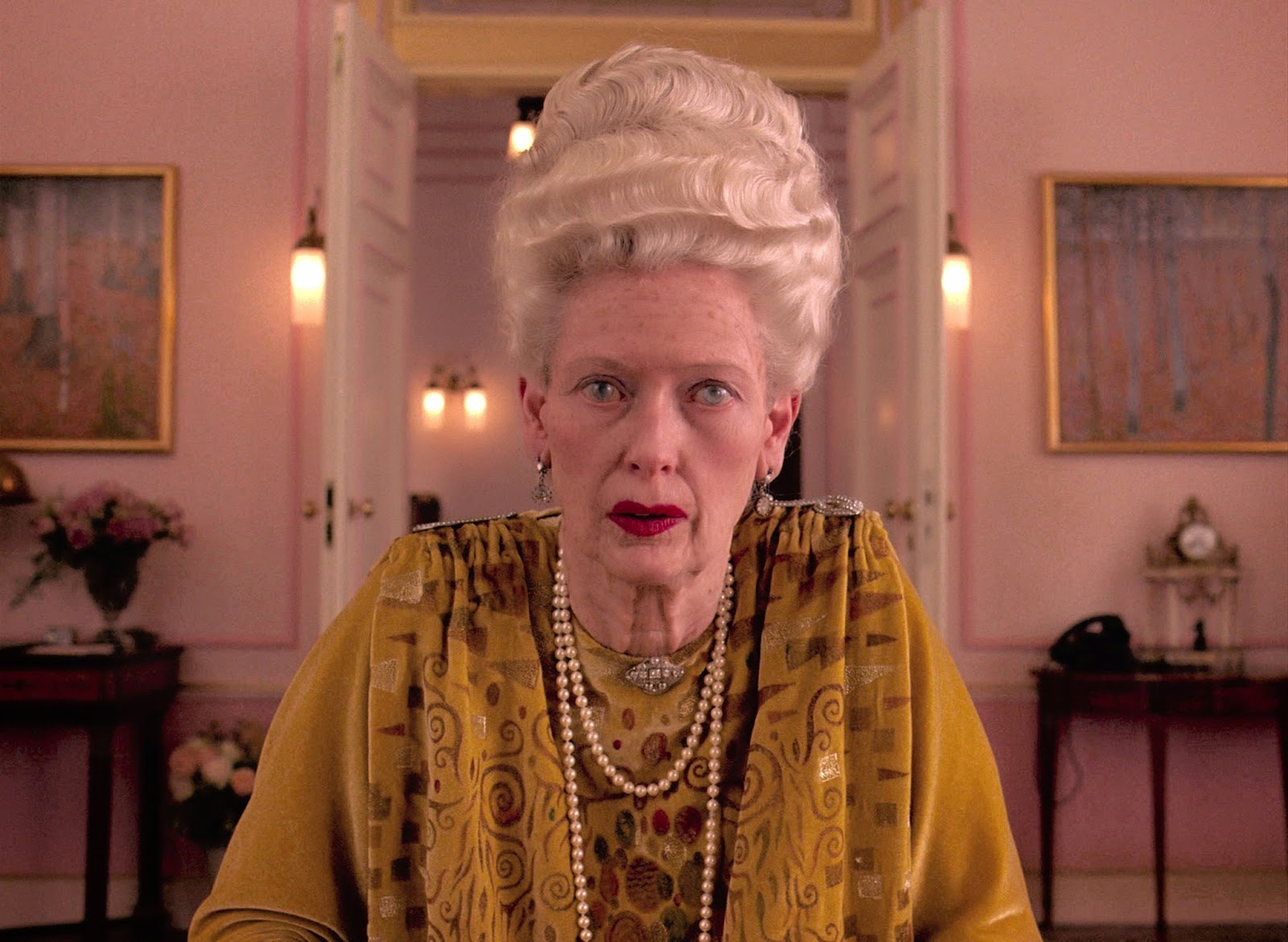
Now the owner of the hotel, Mr. Moustafa relates his story by flashing back to his first days at the hotel when he was a young man named Zero. During this time, the hotel was run by the greatest of concierges, M. Gustave (Ralph Fiennes). A Miranda Priestly, Cecil Gaines, and James Bond all rolled into one ubermensch, M. Gustave understood the needs and wants of every guest that stayed at this English-speaking hotel located in Eastern Europe. He demanded perfection from everyone, but most of all, himself. He was a marvel amongst men and Zero could not have asked for a better teacher. Along with the adoration from the proletariat immigrant Zero, nobody appreciated M. Gustave more than Madame D. (Tilda Swinton), a matriarch overseeing a vast fortune. M. Gustave was Madame D.’s most trusted confidante – in more ways than one.

Madame D. (Tilda Swinton) in The Grand Budapest Hotel.
 
When Madame D. dies, there is a big gathering at her estate. In noble contrast to the leeches, liars and thieves present, M. Gustave and Zero are there, but they are not welcomed by the likes of Madame D’s sons, Dmitri (Adrien Brody) and Jopling (Willem Dafoe). When it is announced by the executor of the estate, Kovacs (Jeff Goldblum), that M. Gustave has inherited an extremely valuable gift, Dmitri and others conspire to destroy M. Gustave and get the valuable gift back.

The best film of Anderson’s film to date, The Grand Budapest Hotel is amusing and it looks spectacular – thanks to director of photography Robert Yeoman, production designer Adam Stockhausen, costume designer Milena Canonero and Frances Hannon, the hair, make-up and prosthetic designer. Sterile, worldly, ornate and whimsical like his other films, you got to hand it to Anderson, whatever his shortcomings are as a storyteller, he has a vision that is unique. Anderson has a distinct style.

The Grand Budapest Hotel is a fun film to watch; perhaps too fun. In his quest to recreate a nostalgic world, full of wonder and adorable characters, Anderson lacks the attack to go after bigger, more consequential ideals. While this is 1930s Eastern Europe, the Nazis are never mentioned by name. In another scene there is a shootout on a hotel floor; this could have been made into a satire on “stand your ground” and the expansion of concealed weapon laws in the U.S., but instead shoots itself into silliness. While in another scene, M. Gustave discusses the advantages of sex with older women, but the accompanying images are made for comical effect.

In addition to Abraham, Brody, Dafoe, Fiennes, Goldblum, Law, Swinton and Wilkinson, The Grand Budapest Hotel also features Mathieu Amalric as the important witness, Serge X,  Edward Norton as the nice "Nazi", Henckels, Saoirse Ronan as Zero's love interest, Agatha, Jason Schwartzman as B-rate concierge, M. Jean, and a funny Harvey Keitel as Ludwig, a shirtless prisoner with twitchy muscles.

It is an impressive cast, but the casting begins to wear out its welcome toward the end when Bill Murray (M. Ivan), Bob Balaban (M. Martin) and Owen Wilson (M. Chuck) and others appear to play throwaway bit parts. Anderson aficionados may find this clever – an inside joke, I suppose; I found it distracting, if not crass.

However, to the credit of Anderson and some casting director on the film (there are many casting directors credited in the film), the filmmakers cast newcomer Revolori to fill a big role while working along with some very accomplished actors. Fortunately, Revolori holds his own as the unlikely orphan-turned-loyal lobby boy who would one day own a hotel.

Zero (Tony Revolori) in The Grand Budapest Hotel.


Monday, 20 January 2014

SUNDANCE 2014: THE DOUBLE

Jessie Eisenberg plays dual roles in The Double.
Simple Simons

By John Esther

Poor, somewhat perverted, Simon (Jessie Eisenberg).  His mother is dying at a disreputable rest home. People harass him on the train to work. The waitress (Cathy Moriarty) at his favorite restaurant gives him sass. His co-workers at a cold data processing center only recognize him when he makes mistakes. And his love life consists of watching, sometimes spying, on his coworker, Hannah (Mia Wasikowska). However, Simon is not all bad; he makes a collection out of Hannah's scraps and he has some good ideas for increasing efficiency at work.

What Simon really needs, or thinks he needs, is to speak to the Colonel (James Fox) via Mr. Papadopoulos (Wallace Shawn).

Imprisoned by his own inertia, Simon's world becomes more complicated with the arrival of James Simon (Eisenberg). A confident, charming young man, James and Simon begin a partnership where James fights for Simon while Simon does James' work, even taking tests for James at work.

However, the partnership is short as James soon works himself into the good graces of Mr. Papadopoulos and into the pants of Hannah. Simon is not so lucky: James' accomplishments are in direct connection to Simon's downfall.

A Spotlight selection at this year's Sundance Film Festival (Spotlight indicates the film previously played somewhere else), director Richard Ayoade (Submarine), screenwriter Avi Korine and production designer David Crank's updated adaptation of Fyodor Dostoyevsky's novella of the same name adds quirky, often very dry humor, to Dostoyevsky's miserable, quasi-existential dread. Alienation does not have to be all nausea, sometimes it deserves a guffaw or two.

Sunday, 6 October 2013

THEATER REVIEW: THE SUNSHINE BOYS

Willie Clarke (Danny DeVito) and Al Lewis (Judd Hirsch) in The Sunshine Boys.
Tax/i-ng times

By Ed Rampell

The best thing about Center Theatre Group’s revival of Neil Simon’s The Sunshine Boys is its canny casting. At the heart of this comedy is the reunion of a hit vaudeville team, Lewis and Clark, who were  known during their 43 year-long run as “the Sunshine Boys,” haven’t performed together -- or seen one another -- for 11 years. It’s therefore a stroke of casting genius to reunite Danny DeVito (Willie Clark) and Judd Hirsch (Al Lewis) -- who co-starred in the beloved, long-running TV sitcom Taxi -- as the estranged vaudevillians. The problem is getting this divided duo back together again is more difficult than the reunification of North and South Korea.

Although I don’t think that DeVito and Hirsch had a rupture similar to that which led to the breakup of Lewis and Clark and their act, this production of The Sunshine Boys at the Ahmanson Theatre marks the first time they’ve worked together since Taxi rode off into the sunset of TV-land in 1983.

This is very much DeVito’s show, as Clark appears in more scenes and has more lines. He performs the schtick audiences have come to love and which he patented and perfected from 1978 to 1983 on ABC and in its final season on NBC as the opportunistic, irascible (and short!) taxi dispatcher, Louie De Palma. One could say that the flamboyant DeVito is playing a version of his screen persona, and he does so with verve and wit. There’s a hint of the reticent, morose, philosophical cabbie (and tall!) Alex Reiger in Hirsch’s portrayal of Lewis, but this seems to be more of depiction tailored specifically for the role Simon wrote.

Their onstage bickering, badgering and bantering is for the most part, amusing and it’s good to see these two old television favorites back together again. (Taxi alumna Marilu Henner and Rhea Perlman attended the premiere, as did Sunshine’s86-year-old bard himself, Neil Simon.) The playwright’s forte and specialty are love/hate relationships, as what is probably his biggest hit -- on the stage, big screen and little screen -- The Odd Couple and its various permutations attests to, as do Simon works such as 1977’s The Goodbye Girl, for which Richard Dreyfuss struck Oscar gold while the film received four other Academy Award noms, including for Best Picture, Simon for Best Writing and Marsha Mason for Best Actress.

The problem is, other than DeVito and Hirsch’s inspired casting, redolent of their offstage back story that mirrors the play’s reunification theme, this production of The Sunshine Boys has little else to commend it. The East Coast Jewish humor is very stale and dates back to 1972, when I saw it on Broadway with Jack Albertson. The opening night crowd at the Ahmanson laughed a lot, but your humble reviewer only smiled at around half the jokes and laughee out loud just a handful of times. Whereas in 1972, the play -- which is not updated -- did not strike me then as being passé and anachronistic, it does now. While the welcome mat is still out for Shakespeare’s far older comedies, this simple Simon play may have  worn out its welcome.

The play really comes alive when Lewis and Clark reteam and perform one of their old vaudeville routines, which within the play’s context they had probably premiered during the 1920s or 1930s. For some reason, the 1970s dialogue is far less funny than the humor from the much earlier period. The bit is enlivened by Annie Abrams’ leggy, busty Miss MacKintosh (get the apples reference?), although some might look askance at this caricature of a sexually attractive woman. With the jokes about the buxom blonde’s derriere and her skimpy outfit Miss MacKintosh might be more at home in a burlesque house or, perhaps, at the Spearmint Rhino, than on a vaudeville stage. Some may also feel that Johnnie Fiori’s turn as an African American nurse has stereotypical elements.

The sets by Hildegard Bechtler, which only change once in this two-acter, are likewise lackluster and Thea Sharrock’s direction is serviceable.


The Sunshine Boys runs through Nov. 3 at the Ahmanson Theatre, 135 N. Grand Ave., Los Angeles, CA 90012. For more info: www.centertheatregroup.org/; 213-972-4400.


Tuesday, 11 June 2013

LAFF 2013: I'M SO EXCITED

A scene from I'm So Excited.
Flying over windmills

By John Esther

When a writer-director of Spain’s Pedro Almodóvar’s stature titles his film after a banal, albeit apropos, American pop song from the 1980s, you know he is aiming for his lowest common denominator.

The opening night film for Los Angeles Film Festival 2012, I’m So Excited commences with León (Antonio Banderas) and Jessica (Penelope Cruz) working on an airport runway. After a minor accident, León learns that Jessica is pregnant with their child. He is so excited he forgets his job and thus puts all the passengers on the plane in serious jeopardy.

While in flight 10,000 feet above terra firma, the plane suffers a malfunction and needs to make an emergency landing. As it searches for a possible landing spot it repeatedly flies in circles. The lower classes are knocked out by a concoction made by the airline stewardesses. Their fate will never be in their hands.

Meanwhile, the first class passengers – a “drug mule” (Miguel Ángel Silvestre), his comatose bride (Laya Martí), a professional assassin (José Luis Torrijo), a man with a string of mentally unstable girlfriends (Guillermo Toledo), a virgin psychic (Lola Dueñas) plus a few other kooky characters -- along with the hysterical flight crew respond to the dire situation with sex, drugs and The Pointer Sisters.

Filled with frank jokes, remarks and marks about sex, especially gay sex, there are some very funny moments, dialogue, etc., that makes I’m So Excited barely bearable – and a de-light-headed choice to open LAFF 2013. Yet the film has its share of very low moments, especially when some of the crew perform the titular song. Ouch.

I’m So Excited screens Opening Night at Los Angeles Film Festival 2013, June 13, 7 p.m., Regal Theaters. For more information: www.lafilmfest.com 


Friday, 12 April 2013

FILM REVIEW: IT'S A DISASTER

A scene from It's a Disaster.
Flirting with terror

By Don Simpson

When everyone arrives at Emma (Erinn Hayes) and Pete's (Blaise Miller) house, they have absolutely no idea just how disastrous this Sunday brunch will become. First their cell phone reception goes dead, then the television goes to static. What? No UT football game? Now the shit gets serious! (Hook 'em!) Cut off from the rest of the world, the four couples are left with a table covered with food and wine, and good old fashioned conversation yet, in a captivating tip of the cap to Luis Buñuel, they never quite get to the food.

This is Tracy's (Julia Stiles) latest boyfriend, Glenn's (David Cross) first time meeting her friends. Glenn is not quite one of the guys, nonetheless Pete, Shane (Jeff Grace) and Buck (Kevin Brennan) try to accept him into their fold. As the outsider, Glenn is the first to get (or not) a hint of Emma and Pete's current dilemma. Glenn also falls prey to Lexi (Rachel Boston) and Buck's open and free relationship. Despite Lexi and Buck's eagerness to fuck anything that moves, their relationship is apparently the strongest of the bunch; even the prolonged engagement of Hedy (America Ferrera) and Shane is apparently at its wit's end.

It is not their disconnection from the outside world or the wail of sirens that rattles this bunch. Instead, it is a cameo by writer-director Todd Berger that kicks the tension into high gear. Each character's reaction to Berger's cleverly injected news represents a different stage of grief. When the shit hits the fan, we quickly learn what is more important: interpersonal relationships or survival instincts? For these self-involved thirtysomethings, it seems to be the former; well, except for Shane, the token paranoid conspiracy theory nut of the bunch.

It's a Disaster is an impeccably-written, dark-as-a-moonless-night satire that hearkens back to the glory days of classic comedy. Existing in the surreal ether somewhere between Preston Sturges and Woody Allen, Berger takes on disaster films as well as the trope of trapping characters in one location -- all the while, Berger and cinematographer Nancy Schreiber beautifully choreograph the on screen events to Altman-esque precision.

Berger's film is a sardonically-scribed social commentary on the priorities of privileged white thirtysomethings. By definition, terrorism incites terror; but, the characters of It's a Disaster diffuse the terror of terrorism by being so damn self-involved. Sure, in due time they all eventually react to the terror that surrounds them but, one thing can be certain, the characters of It's a Disaster do not initially react the way the terrorists had hoped. God bless America and god bless Todd Berger -- now just give me a sip of that god-damned Merlot.

Monday, 24 December 2012

FILM REVIEW: THIS IS 40


Desi (Meagen Fox) and Debbie (Leslie Mann) in This is 40.
 Age or IQ?

By Ed Rampell

I’m not a Judd Apatow fan and, like many moviegoers who’ve already reached puberty, I find much of his work to be puerile, juvenile, etc. I shudder to apply the term “auteur” to this over-the-top writer-director-producer, just as calling Tyler Perry one likewise induces nausea. So I was surprised at how much I enjoyed This is 40. Yes, it has the usual Apatowian obsession with body parts and bodily functions, but since This is 40 deals with an older generation instead of teens, Apatow has graduated and moved up to Viagra and hemorrhoid jokes.

This is 40 is being hyped as a sorta sequel to 2007’s Knocked Up, wherein Apatow’s usual immaturity reduces sexuality to an act that leads to childbirth and the hyper-responsibility of parenthood that more or less precludes recreational sex. Fortunately, This is 40 does not focus on the annoying Seth Rogen and cloying Katherine Heigl, who, like bad needles stuck in the groove of damaged LPs, both seem to play the same role over and over again (give or take a Green Hornet or two). Luckily, this dull duo are not in This is 40, which features Knocked Up’s other couple, Pete and Debbie, who are played by Paul Rudd and Leslie Mann.

As the title suggests, This is 40 deals with these married non-virgins as they hit the Big Four-0. Since we met Pete and Debbie last, in just five years they somehow managed to spawn a teenager, Sadie, plus another daughter, Charlotte, who is older than five -- but never mind, this is the movies. (BTW, both girls are portrayed by Apatows real life daughters, Iris and Maude.) Nevertheless, one of the best things about This is 40 is that it kind of unspools like real life. As both Pete and Debbie turn 40 in the same week they’re faced with not only the anxieties of aging -- at first, Deb is in a state of denial -- but problems with their own parents/in-laws, raising their own kids and perhaps most tellingly, financial problems. Depression, after all, is an economic as well as psychological term.

This is the strongest element of This is 40, which joins the ranks of recent features such as Up in the Air and The Company Men in rather realistically relating how today’s bad economy is negatively affecting people’s lives. In addition to the financial meltdown, Pete has to contend with changes brought on by technology. The Internet has wrought wonders, but in its wake New Media has devastated much of  the old, especially in book/magazine/newspaper publishing and in the music industry. Pete has chosen this moment in time to open an independent record label and his efforts to launch the 60-something artist he’s signed  (Graham Parker) runs into the head winds of the new realities of the digital world, with its free downloads, intellectual property theft, et al. Meanwhile, Debbie’s boutique is beset by an unaccountable theft of merchandise and loss of income.

Along with the dire needs of Pete and Debbie to downsize their entire lifestyle, the other really good thing about This is 40 is its cast. Parker, who had a hit album back in 1975, plays himself as the aforementioned British rocker, who today suffers from gout. This musician is joined by Albert Brooks as Larry, Pete’s Minnie the Moocher dad, a failed businessman. It’s curtains for this curtains salesman, who is reduced to panhandling and taking handouts from his son, especially to keep his second, much younger family afloat amidst the flotsam and jetsam of our collapsing capitalist economy. It’s always a joy to see Brooks onscreen, and he is a sight for sore eyes as he kibitzes with his son and quibbles with his daughter-in-law.

As Debbie’s absentee dad, the highly paid, surgeon Oliver, John Lithgow provides a stark counterpoint to Larry. Is it better to have a broke ass dad who always has his hand out or a well-to-do father who’s never around? At least Oliver’s making an effort in this film.

As the boutique saleswomen Desi and Jodi, Megan Fox and comedian Charlyne Yi also add to the overall merriment. Which of them have been stealing from Debbie’s shop? The hot Desi screws a customer on the boutique’s counter and has a deep, dark secret of her own. Yi gods -- this comedian is nuts! Yi played a character named Jodi in Knocked Up and starred in and co-wrote her own skewed take on love in 2009’s Paper Heart, so it's good fun to see this quirky, goofy comic back on the big screen.

Meanwhile, as the story unfolds -- kind of horizontally instead of vertically, as many lives do -- Pete and Debbie alternately argue, have a charming romantic interlude, fret over finances, try to raise their daughters in this troubled age, and somehow keep themselves afloat as they turn 40 and face uncertainty plus the prospect of middle age. Unfortunately, unlike most of us treading water in this economy that forces more and more of us to join the ranks of les miserables, Pete and Debbie have escape hatches unavailable to most of us. But aside from this -- after all, Apatow isn’t exactly a message moviemaker like Michael Moore -- This is 40 is a pretty realistic, highly enjoyable look at a modern couple and their very contemporary, daunting woes, as they try to keep their heads, and the heads of their relatives, above water.                       


Monday, 30 July 2012

FILM REVIEW: THE WATCH

A scene from The Watch.
American style Snatch

By Don Simpson

Akiva Schaffer's The Watch opens with a not-so-clever bit about white bread life in the American Midwest. As Evan (Ben Stiller) jogs around his utopian, suburban town the joke seems to be on him. Evan wants to have a lot of friends, especially ethnic ones. He has an Indian friend, a Korean friend, and he is currently in the market for a black friend. (This all seems like a badly conceived SNL sketch.) This is why Evan has started a bunch of crazy clubs -- running club, Spanish club, etc. -- to force people to hang out with him.

Evan is the manager of the local Costco. On one fateful night, Evan runs into the nighttime security guard, Antonio Guzman (Joe Nunez), a Hispanic immigrant who has just passed his U.S. citizenship exam. Evan is quite proud of his growing collection of ethnic friends; now that Antonio is a card-carrying member of the U.S. of A., he becomes another trophy for Evan's mantel.

Just when it seems The Watch has pushed Evan's acceptance of "others" a bit too far, the film turns into an alien invasion flick -- specifically an alien invasion flick in which aliens might be disguised as humans. We have all seen Invasion of the Body Snatchers, right? Well, it is impossible to tell if The Watch is lampooning the fear-mongering that is inherent in aliens-disguised-as-humans films like Invasion of the Body Snatchers, or if it is actually taking its own plot seriously. In fact, nothing is ever what it seems, especially The Watch's opinion of "others," as well as its opinion of Evan and his neighborhood watch crew -- Bob (Vince Vaughn), Franklin (Jonah Hill), and Jamarcus (Richard Ayoade).

The gaggle of screenwriters -- Jared Stern, Seth Rogen, Evan Goldberg -- obviously tries to set up Evan as being overly accepting of "others" then turn his world so upside down that he is forced to fear practically everyone. If they could pull that trick off more smoothly, maybe the plot of The Watch would be more effective. Instead, the much-too-clever-for-their-own-good screenwriters muddy up the narrative with a lot of useless information, primarily Evan's sexual issues and Bob's parenting issues. All the while, Franklin is revealed to be a one-dimensional caricature of a nutso vigilante and Jamarcus is...well...just another geeky British guy played by Ayoade.

The Watch tries to be a very masculine film, saturated with mindless, testosterone-fueled humor. I can sometimes deal with "manly" (in this case, boyish) jokes, but even the fleeting memories of the film's long-winded sketch mocking the Abu Ghraib photos still completely spoils my mood. The script is fascinated with the masculine need for dominance, whether it be by using a penis, gun or knife. The Watch seems overly fixated on male genitalia (and other phallic metaphors), continuously going out of its way to squeeze in as many penis and cum jokes as possible. The women of The Watch are embarrassingly passive, sexual objects. Using the logic of The Watch, anyone (especially women) without a fully functioning penis (or gun) is powerless. Instead, women are repeatedly represented as vacant orifices that serve as mere receptacles for penises, including Evan's sex-starved wife, Abby (Rosemarie DeWitt). Heck, even the aliens want a piece of that action.

Tuesday, 17 July 2012

OUTFEST 2012: MY BEST DAY

Karen (Rachel Style) in My Best Day.
Thawed relationships

By Miranda Inganni

It is the Fourth of July and sparks will fly around a small town after a phone call in writer-director Erin Greenwell’s wonderfully crafted film, My Best Day.
Karen (Rachel Style) is bored and annoyed. While others enjoy the holiday independently from work, Karen is stuck answering phones for a repair shop. Assuming the normal tedium, Karen’s day changes after she receives a call from a man with the same name as the father of hers she has never knew.
Eager to find out if the man is her father, Karen takes a trip to the next town over with the help of her friend, Meagan (Ashlie Atkinson). Meagan is going through a bit of a bout of relationship woes and recently has purchased a motorcycle -- perchance for a ride to freedom with an attractive, new love interest. With Meagan posing as the fridge repair person, the two young women get involved with Karen’s newly reunited family.
Subtle, nuanced hilarity ensues.
Karen reconnects with her half-sister, Stacy (Jo Armeniox), whose life has been overwhelmed by a gambling problem, while meeting her younger half-brother, Ray (Robert Salerno), who spends his day fighting with neighborhood bullies while trying to win over his first love. Then there are the nutty cops, a guy in search of meatless meat and host of smaller, small town folk.
Greenwell’s writing is superb and the cast of characters is extremely well acted, if not just exceptionally well cast. Characters are comical yet recognizable, making My Best Day one of the better films of the Outfest film festival.


Friday, 29 June 2012

FILM REVIEW: TED

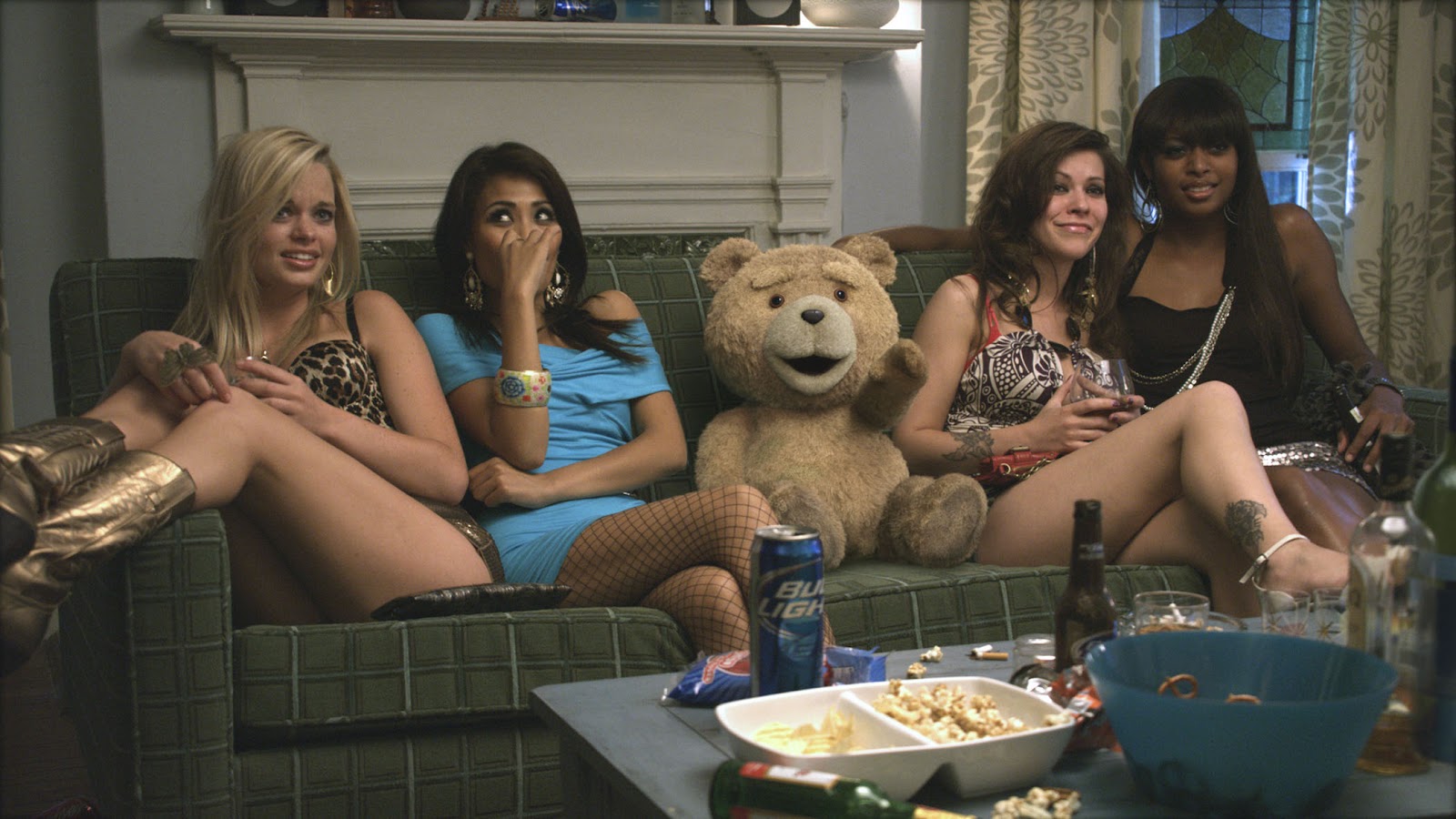
A scene from Ted.
Barely bearable

By John Esther

Way back in the 1980s there was a boy named John (Bretton Manley). John was so lonely not even Greenbaum (Max Harris), the Jewish kid frequently beaten by the ungentle gentile kids, would play with John.

Then one Christmas morning John receives a special gift: a teddy bear. John and the teddy bear do everything a boy and a teddy bear can do. But it is not enough. John wishes Ted could talk.

Low and behold the next morning Ted (voice by Zane Cowans) is a walking and talking Teddy Bear. John has a best friend, a sui generis Snuggles to call his own. The clever boy names the teddy bear Ted. As the world's first talking stuffed animal, for a few fleeing moments Ted becomes quite famous and proverbially belongs to the crowd, but Ted and John will always be "Thunder Brothers" for life.

Flash forward 27 years later. The scientific, military, and religious community, plus the rest of the world, have all accepted a talking teddy bear as just something that is a part of the world. (In the real world they would have torn him apart for answers.) A pop culture flash in the pan, today the  beer-swishing, bong-banging, anti-Semitic, racist, sexist Ted (voice by Seth MacFarlane) is hanging out with his best buddy, John (Mark Wahlberg).

As inseparable as Ted and John have been all of these years, John has managed to develop a relationship with Lori (Mila Kunis),  a -- here we go, again -- woman who is, for the most part, out of John's league. (Do women ever get tired of watching female film characters settling for less in love?)

Lori has showed a considerable amount of patience over the past four years, waiting for John to get his act together but, at the moments where the storyline in the film picks up, she has just about had enough of John and Ted. What are a man and his teddy buddy to do? Well, get high, get crazy, then serious, then crazy, then stupid, then drunk, then high, horny, cry, plea, deny, fail, reunite, save...until the predictable and hackneyed ending.

Written and directed by MacFarlane, the brilliant and very cynical creator behind Family Guy and many other television shows, Ted, like those shows, is full, if not masturbatory, nods to pop culture -- usually of the populist type. Nods to TV, blockbuster films, pop singers and the ilk are the themes MacFarlane's texts are mostly made of and Ted takes the brow down with few efforts to enlighten his audiences. The Søren Kierkegaard quote in the film does not fit, but what does a stoned, horny stuffed teddy bear without a penis know about philosophy?

Some of these ir-reverent pop references are quite funny -- such as a Bourne-inspired fighting scene in the hotel room; a Flash Gordon metanarrative; a Tiffany video "cameo"; and the film's own nod to its creator ("He thinks my voice sounds like that Peter Griffin"). For the most part, those are the funniest parts in the film -- although I had to bite my tongue to stop laughing at Ted's impersonation of a trashy Boston woman having sex. MacFarlane knows American pop culture and, when at his best, he uses it in a critical way that is hilarious.

MacFarlane is also intelligent when it comes to American politics as well, but that does not show in Ted, unless you consider Ted a synecdochefor mind-numbing Americans, albeit of various ages, who are not adverse to disliking Mexicans, blaming dark skinned people for 9/11, making anti-Semitic jokes and treating women like sex objects. But Ted does not play Ted that way. Ted insults women and minorities and we are supposed to laugh. At least much of the audience at the screening I attended did laugh at such sentiments.

The film also sends quite a few mixed messages about gay men. One the one hand, Ted is a homophobe whose anti-GLBT jokes are supposed to be funny (they are not) and John's co-worker, Guy (Patrick Warburton), gets beat up at gay bars and yet he does not know why. But on the other hand, or eventually, Guy meets and falls in love with another man (Ryan Reynolds) and the film treats the relationship with respect.

Ted is definitelya mixed bag, a movie trying to reach the largest audience, even if that means lowering itself to a lower common denominator. Ted has its middle, low and lower moments. For every time I laughed until tears rolled down my face there was another moment where I cringed.

In a way Ted reminded me of Gasper Noé's Irreversible, but I have to stop here.


Sunday, 17 June 2012

LAFF 2012: THE HISTORY OF FUTURE FOLK

A scene from The History of Future Folk.
And then the laughs stopped

By Ed Rampell

J. Anderson Mitchell and Jeremy Kipp Walker’s The History of Future Folk is an exceptionally clever sci-fi send up that is a hoot from beginning to almost the very end. The core of this genre spoof is an oft repeated staple of science fiction, seen in My Favorite Martian, Alf, Mork and Mindy, E.T., et al: Unbeknown to us, visitors from another planet mingle amongst we unsuspecting earthlings. Sheer hilarity (or sometimes high drama) ensues as we follow these cosmic fish out of water consorting with mere mortals. Indeed, E.T.’s famous scream as Drew Barrymore stumbles upon the extraterrestrial hiding in her home is wittily lampooned in Future Folk.

The coded message of these productions asks the same question that the late and much lamented Rodney King posed: “People, can we get along?” Usually, the space aliens have superior technological powers, but discover something lovable about Homosapiens, despite our foibles, that make us worthy of not being wiped off the face of the Earth. (Hey, that’s mighty otherworldly of you!) Sometimes, what redeems us in the bug eyes of those little green men is our flawed species’ gift of that crazy little thing called love.

In The History of Future Folk the interplanetary interlopers from Hondo stumble upon humanity’s ability to create music. This endears human beings to Bill (AKA General Trius, drolly played by Nils d’Aulaire) and the Mighty Kevin (Jay Klaitz, as the klutzy alien), who have indeed been dispatched on genocidal cosmos-trotting missions to, shall we say, force earthlings to vacate the premises so Hondo’s denizens can resettle our lonely piece of real estate. But the intergalactic intruders become so enamored of music that they form a bluegrass duet, rocking the casbah nightly at a Brooklyn joint.

And yes, our guitar strumming, banjo picking outer space Simon and Garfunkel do commit intergalactic miscegenation, falling in love with earthy Earth girls. Kevin’s tango with off duty NYPD officer Carmen (April Hernandez) is a virtual laugh riot.

Future Folk’s endearing low budge, Ed Wood-like “special effects” include what appear to be upside down plastic buckets-cum-astronaut helmets. Alas, this people’s history of outer space also commits the cardinal sin of genre spoofs: It starts at some point to take itself seriously re: General Trius’ triage. Just as Seth Rogen’s 2011 The Green Hornet made fun of superhero conventions then became just another costumed crusader flick, The History of Future Folk assumes the attributes of sci-fi, and instead of playing it for laughs, makes the mistake of playing it straight. But don’t the filmmakers realize everyone laughs at the court jester -- until he stops telling jokes? You’re supposed to parody genre conventions, not repeat them. Nevertheless, for most of the ride Future Folk is good fun, until it runs out of rocket fuel.


The History of Future Folk screens at the Los Angeles Film Festival: tonight, 7:30, Regal Cinemas.


Sunday, 12 February 2012

THEATER REVIEW: 20TH CENTURY

Myrtle Clark (Beth Leckbee) in 20th Century.
Backward times

By Ed Rampell

There’s no reason to board a streamlined train and chug down (or rather up) to the Sierra Madre Playhouse to see 20th Century – unless, that is, you relish experiencing laugh riots on the live stage. Bard Ken Ludwig’s adaptation of Ben Hecht and Charles MacArthur’s 1930s play and movie versions of 20th Century retain the rat-a-tat repartee of this screwball script, while Michael Lorre’s adept direction maintains the comedy’s madcap pace.

Egomaniacal theatre impresario Oscar Jaffe faces personal and professional ruination -- unless the producer can persuade his ex, movie star Lily Garland, to return to the footlights on the Great White Way to play the lead in a Jaffe production. Oscar woos and wows Lily with promises of the greatest female role ever in a Broadway adaptation of the age-old “Passion Play” – which, the fading showman hopes, will restore both his show biz fortunes and relationship with Lily.

Unlike in the 1934 film version this entire theatrical production takes place aboard the fabled 20th Century Limited train as it speeds from Chicago to New York’s Grand Central Station. Kudos to set designer Adam Smith, who has turned the Playhouse’s stage into the interior of a streamliner worthy of, well, the wealth of nations. A little motion, however, would enhance the illusion of being on a swiftly moving train, but that’s a mere quibble, as the set, with its luxury lounge, sleeping quarters, et al, is a co-star.

Arthur Hanket as imperious Oscar, however, is the first among equals in this ensemble cast composed of zany characters brought to life by zesty actors. With his wild grandiose mood swings and theatrical elocution, Hanket steals every scene he’s in. (In Charles Bruce Milholland’s source material, Oscar was reportedly inspired by producer David Belasco, the so-called “Bishop of Broadway.”) In Howard Hawks’ 1934 movie, John Barrymore portrayed Oscar, and hammy Hanket does the “Great Profile” proud.

As Lily Garland (uh, or is that the character’s real name?) Stephanie Hanket Erb holds her own in the role Carole Lombard immortalized onscreen. In his efforts to win the winsome actress who has gone Hollywood back to him and the legit stage, it’s no holds barred for Oscar. He discovered and knew Lily when, and holds this over her head with relish.

The rest of the ensemble cast keeps up with the leads’ onstage antics. In a dual role, Grant Bociocco depicts a female nurse and goes all Groucho as rival producer Max Jacobs. La-La-Land denizens are used to wannabe writer/ waiters with scripts in their pockets waiting to pounce on celebs and suits, but Barry Saltzman has a comic turn as an adulterous doctor, no less, aspiring to turn in the stethoscope for the stage. Another standout is Beth Leckbee as Myrtle Clark, who plays an atheist’s delight: A bible thumper running amok aboard the train who, like many religious zealots, is filled with delusions – which are only matched by Oscar’s Newt Gingrich-like delusions of grandeur.

This character and the “Passion Play” subtext, however, triggered a religious controversy and attempts at censoring the 1934 screen version. The Hays Office, which oversaw the then-recently enforced notorious Hollywood Production Code, was anxious about the show's implicit critique of Christianity. The Hays Office's Grand Inquisitor, Joseph Breen, was nervous that “there will be serious difficulty in inducing an anti-Semitic public to accept a [motion picture] play produced by an industry believed to be Jewish in which the ‘Passion Play’ is used for comedy purposes.”

Furthermore, the Clark character (male in the movie) is what we would today call a fundamentalist, evangelical Christian who ends up in a mental asylum. Interestingly, the only actor from the Broadway play who was also in the film’s cast was Etienne Girardot, who portrayed this proselytizer. Given the current brouhaha over religion -- from the Planned Parenthood dispute to the controversy between the Obama administration and Catholic hospitals over contraceptives -- this topic remains timely.

Another important point is that 20th Century was co-written by a Jew, Ben Hecht, whose screen credits include the 1930s classics Scarface and Nothing Sacred. In 2009 I saw a remarkable play called The Accomplices about the FDR administration and American Jewry during the Holocaust, and while many closed their eyes, nobody else did more to raise the alarm about what was befalling European Jewry before the U.S. entered WWII than “premature antifascist” Hecht. This courageous playwright/screenwriter was the great American champion of the victims of the Shoah, who campaigned relentlessly on their behalf in the press and staged star studded mass fundraisers at venues (such as, I believe, Madison Square Garden), to rouse the conscience of Roosevelt and the world before it was “safe” to do so

20th Century runs through March 17 at the Sierra Madre Playhouse, 87 W. Sierra Madre Blvd., Sierra Madre, CA 91024. For tickets and info: (626)355-4318; www.SierraMadrePlayhouse.com.