Showing posts with label saoirse ronan. Show all posts

Friday, 7 March 2014

FILM REVIEW: THE GRAND BUDAPEST HOTEL

M. Gustave (Ralph Fiennes) in The Grand Budapest Hotel.
Concierge can(dan)dy

By John Esther

Inspired by the writings of Stefan Zweig -- a middlebrow, middle class, Viennese, classically liberal author who was very popular throughout many parts of Europe and the U.S. in the 1920s and 1930s — the latest film by Wes Anderson (The Royal Tenenbaums; Moonrise Kingdom) follows the adventures of a cunning(lingus-t) concierge named M. Gustave (Ralph Fiennes) and his loyal sidekick, Zero (Tony Revolori), who must outwit robbers, a psychopath killer, and the law as 1930s Europe begins to fall prey to a sinister form of government.

The film opens up in a charming manner with Author (Tom Wilkinson) giving us viewers a lecture on where authors draw his or her source materials. To prove his point, he tells us the story about when he was a younger author (now played by Jude Law) and his encounter with Mr. Moustafa (F. Murray Abraham) during the final days of the titular hotel.

Now the owner of the hotel, Mr. Moustafa relates his story by flashing back to his first days at the hotel when he was a young man named Zero. During this time, the hotel was run by the greatest of concierges, M. Gustave (Ralph Fiennes). A Miranda Priestly, Cecil Gaines, and James Bond all rolled into one ubermensch, M. Gustave understood the needs and wants of every guest that stayed at this English-speaking hotel located in Eastern Europe. He demanded perfection from everyone, but most of all, himself. He was a marvel amongst men and Zero could not have asked for a better teacher. Along with the adoration from the proletariat immigrant Zero, nobody appreciated M. Gustave more than Madame D. (Tilda Swinton), a matriarch overseeing a vast fortune. M. Gustave was Madame D.’s most trusted confidante – in more ways than one.
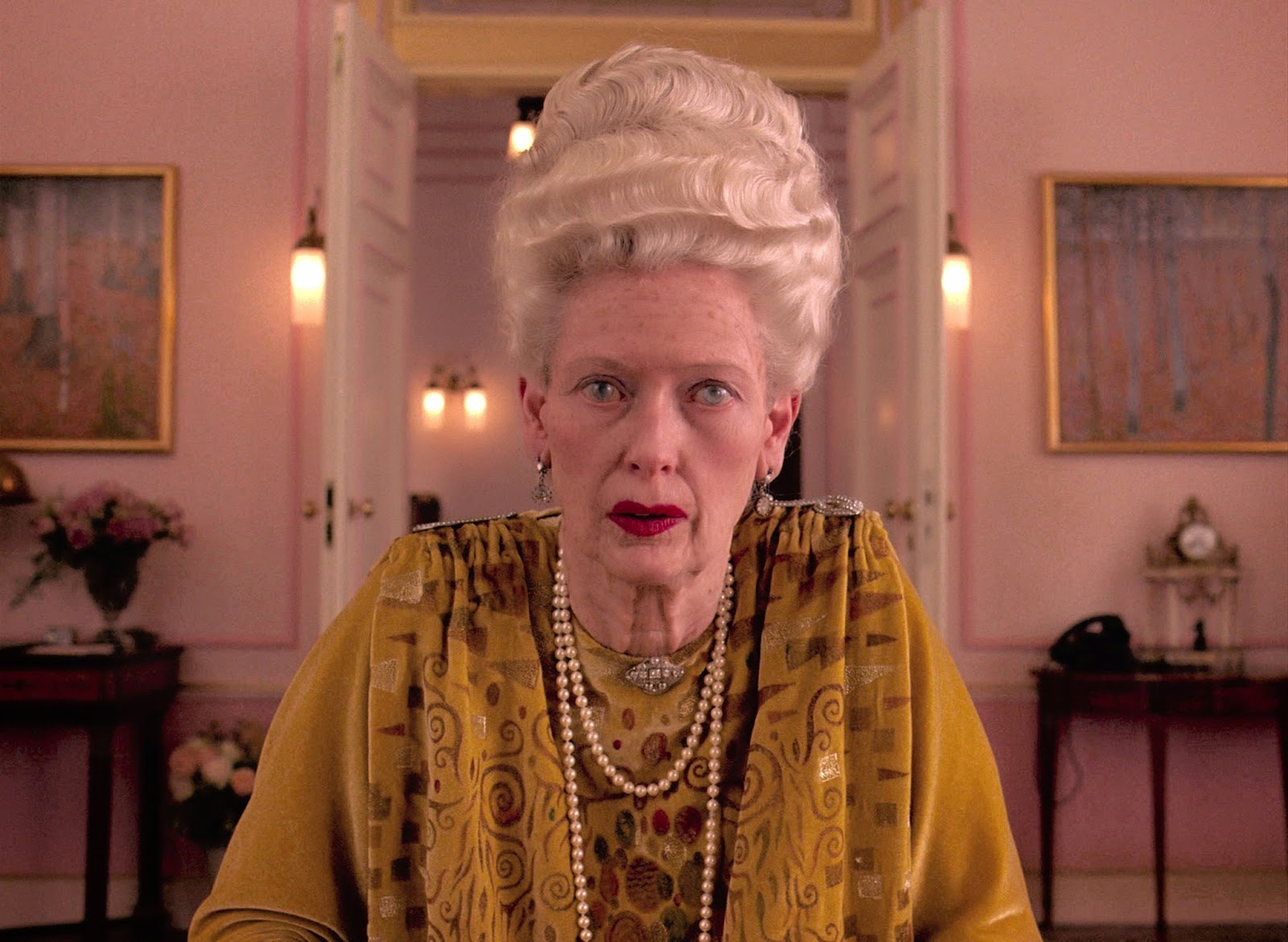
Madame D. (Tilda Swinton) in The Grand Budapest Hotel.
 
When Madame D. dies, there is a big gathering at her estate. In noble contrast to the leeches, liars and thieves present, M. Gustave and Zero are there, but they are not welcomed by the likes of Madame D’s sons, Dmitri (Adrien Brody) and Jopling (Willem Dafoe). When it is announced by the executor of the estate, Kovacs (Jeff Goldblum), that M. Gustave has inherited an extremely valuable gift, Dmitri and others conspire to destroy M. Gustave and get the valuable gift back.

The best film of Anderson’s film to date, The Grand Budapest Hotel is amusing and it looks spectacular – thanks to director of photography Robert Yeoman, production designer Adam Stockhausen, costume designer Milena Canonero and Frances Hannon, the hair, make-up and prosthetic designer. Sterile, worldly, ornate and whimsical like his other films, you got to hand it to Anderson, whatever his shortcomings are as a storyteller, he has a vision that is unique. Anderson has a distinct style.

The Grand Budapest Hotel is a fun film to watch; perhaps too fun. In his quest to recreate a nostalgic world, full of wonder and adorable characters, Anderson lacks the attack to go after bigger, more consequential ideals. While this is 1930s Eastern Europe, the Nazis are never mentioned by name. In another scene there is a shootout on a hotel floor; this could have been made into a satire on “stand your ground” and the expansion of concealed weapon laws in the U.S., but instead shoots itself into silliness. While in another scene, M. Gustave discusses the advantages of sex with older women, but the accompanying images are made for comical effect.

In addition to Abraham, Brody, Dafoe, Fiennes, Goldblum, Law, Swinton and Wilkinson, The Grand Budapest Hotel also features Mathieu Amalric as the important witness, Serge X,  Edward Norton as the nice "Nazi", Henckels, Saoirse Ronan as Zero's love interest, Agatha, Jason Schwartzman as B-rate concierge, M. Jean, and a funny Harvey Keitel as Ludwig, a shirtless prisoner with twitchy muscles.

It is an impressive cast, but the casting begins to wear out its welcome toward the end when Bill Murray (M. Ivan), Bob Balaban (M. Martin) and Owen Wilson (M. Chuck) and others appear to play throwaway bit parts. Anderson aficionados may find this clever – an inside joke, I suppose; I found it distracting, if not crass.

However, to the credit of Anderson and some casting director on the film (there are many casting directors credited in the film), the filmmakers cast newcomer Revolori to fill a big role while working along with some very accomplished actors. Fortunately, Revolori holds his own as the unlikely orphan-turned-loyal lobby boy who would one day own a hotel.

Zero (Tony Revolori) in The Grand Budapest Hotel.


Thursday, 7 April 2011

FILM REVIEW: HANNA

Hanna (Saoirse Ronan) in Hanna.
Wolfing down the candy

By Don Simpson

See Hanna hunt. See Hanna shoot. See Hanna run. See Hanna kill! Kill, Hanna, kill!

When we first meet the titular Hanna (Saoirse Ronan), she is hunting reindeer for survival in the harsh wintry environment of snow-swept Finland. All the while, her father Erik (Eric Bana) challenges Hanna to kill better, run faster, and get stronger in order to protect herself from the big bad wolf...I mean, world.

We come to learn that Erik has shielded Hanna from the outside world ever since her mother died. Together they have been hiding completely off the grid in a secluded forest cottage in Finland while Hanna has been tirelessly training. Now 16-years old, Hanna begins to get itchy to experience more than just life with her father; so Erik promptly unearths a box -- a transmitter of sorts -- with a switch. When Hanna feels as though she is totally ready, all she needs to do is flip the switch. Erik warns Hanna that her life post-switch will not be easy. Hanna will have to go at it alone. There is an evil CIA agent, Marissa (Cate Blanchett), who is allegedly responsible for the three bullets that killed Hanna's mother. Once the switch is flipped, Marissa will know that Erik and Hanna are alive, and she will go to the extremes to hunt and kill them.

The switch is officially flipped and the game begins. Hanna is off, traveling from one exotic locale (Morocco, Spain, Germany) to the next with Marissa and her evil henchmen -- the ridiculously flamboyant, Isaacs (Tom Hollander), and his two neo-Nazi sidekicks (Sebastian Hülk and Joel Basman) -- never far behind. Run faster, Hanna! Run faster!

Hanna was raised in complete isolation; suddenly as a 16-year old she is catapulted into the modern world, making Hanna a female coming-of-age metaphor on steroids as Hanna goes from being a sheltered little daddy's girl to full independence in ten seconds flat. 

Hanna is remarkably intelligent and a hyper-polyglot, but when it comes down to it, Hanna is an empty vessel who must immediately begin to consume the wonders of the world around her with the same childlike naiveté of Being There's Chance and  The Man Who Fell To Earth's Thomas. Hanna welcomes electricity and magic with much trepidation, but she certainly adapts to navigating the Internet on a computer quickly enough. 

Unfortunately, it soon becomes apparent that Hanna has been training all of her life, not for her own safety, but for the sole purpose of killing Marissa. It is never really explained why Erik believed it to be prudent to raise a child to murder his nemesis, rather than doing it himself (something he seems more than capable of doing). Maybe I am not supposed to ask questions about this -- perhaps I am supposed to sit back and be in awe of la petite femme fatale -- but I really want to know why?

Before I proceed, I need to get something off of my chest: Ronan is absolutely amazing. If not for her, I more than likely would have hated Hanna. Ronan's high caliber of acting lifts this high octane "girl kicks ass" flick to somewhat respectable heights. It also helps that director Joe Wright admirably keeps Ronan in respectable attire, never once allowing the camera to sexualize her. Hanna quickly develops into a carefully nuanced character whose strength and rage actually seem logical, and except for her unrealistic speed and catlike reflexes, Hanna's fighting skills seem relatively grounded and realistic. And, yes, it is nice to see a young, independent girl handle herself so skillfully in the real world as she takes on men two or three times her size, squashing them like little girlie ants.

Unfortunately, Wright (whose previous directing credits -- Pride & Prejudice, Atonement, and The Soloist -- could not be farther from the cinematic hyperactivity of Hanna) is presumably having too much fun providing the audience with a relentless shock and awe barrage of eye candy (some of which is quite magnificent, I must admit) to care about the narrative. Hanna, my friends, is a hyper-stylized action flick through and through. Most of the non-action sequences are inconsequential, except for Ronan's eerily powerful presence which carries each and every scene. For one reason or another, some of the action sequences are better choreographed and directed than others. The editing and the visual bravado of the prison escape sequence alone is worth the admission price. Come to think of it, from the opening titles until Hanna emerges from the prison, Hanna is near perfect, but from that point onward, the film dillies and dallies way too much (with little meaningful plot development). The most disappointing action sequence of them all takes place during the anticlimactic climax at Grimm's house in Berlin (a reference to the absurd fairy tales Hanna was raised on) which then leads directly into the incredibly predictable ending in which a big bad wolf metaphor falls flat on its furry face -- too bad Hanna is not donning a red hoodie -- and the opening lines of dialogue (“I just missed your heart”) turn out to be the most heavy-handed use of foreshadowing in film since Alfred Hitchcock.

There is very little music in Hanna, but as soon as each action sequence is about to commence the block-rockin' beats of The Chemical Brothers are predictably raring to go. It is like clockwork, and it is all part of Wright's annoying formula: music kicks in, a chase begins, then a fight, music stops, the scene ends. Unfortunately, the soundtrack (The Chemical Brothers' lackluster attempt at German techno?) makes Hanna's action sequences play out a hell of a lot like Run, Lola, Run (analogies to Salt and Æon Flux are also just waiting to be noticed).

Last, but certainly not least...the accents! Hardly anyone in Hanna speaks in their native accent. (I trust that this is a purposeful decision on Wright's behalf to add another level of falsity to the mix.) Blanchett speaks in an irritatingly inconsistent American Southern belle accent that lacks of any particular purpose other than to be like nails on a chalkboard. (The only aspect of Hanna that is more annoying than Blanchett's accent is the Isaacs character, who fulfills every single cheesy cliché from the 1980s action film villain's handbook...but not in a good way.) Bana's German accent fares a little better but he constantly slips in and out of it. Really the only non-native accent that is truly convincing is Ronan's. I would have never guessed she was born in New York and raised in Ireland.