Friday, 21 March 2014

FILM REVIEW: THE MISSING PICTURE

A scene from The Missing Picture.
Phnom Penh, mon amour

By John Esther

One of my favorite films of 2013, writer-director Rithy Pahn film is finally getting a proper release in the United States. 

On April 17, 1975, the 13-year-old Panh, his family and others were evacuated from Cambodia’s capital, Phnom Penh, to the countryside where they could finally learn what it meant to be loyal to the Khmer Rouge. A pseudo-communist regime, the Khmer Rouge was anti-bourgeois in the extreme. While they shared a similar distaste for middle-class materialism that many left-wing groups did, they took it to the extreme and out of context. All comfort was anti-revolutionary. 

More importantly, as a peasant uprising run amok, the Khmer Rouge was horribly anti-intellectual. Learning beyond man as a tool for the agrarian socialist revolution was subversive and must be eliminated by any means necessary. According to the Khmer Rouge, and their leader Pol Pot, who was actually an educated person, people of culture, humanities, the arts, music, literature, etc., were better off dead. The supposed left had become extremely right. 

This would be one of the lessons Panh would learn over the next four years as nearly all of his family perished one way or another. And to his credit, he emphasizes how deadly a mistrust of the intellect existed in the country.

Since nearly everything was destroyed during those years, Pahn recreated his childhood memories through the use of figurines. A painstaking endeavor, Pahn uses hundreds of figurines set in elaborate dioramas to convey his characters and extras.

The result is a stunning mediation on loss and memory, with no shortage of anger to boost the narrative.

Paradoxically, this was Cambodia’s Oscar entry for this year’s Oscars in the Best Film in a Foreign Language category, but it lost to Italy’s much happier, bourgeois-friendly and inferior film, The Great Beauty.

FILM REVIEW: MUPPETS MOST WANTED

A scene from Muppets Most Wanted. 
Bounty-full fun

By John Esther

Picking up where The Muppets in 2011 ended, Muppets Most Wanted sees the gang touring across Europe, thanks to their new co-manager, Dominic Badguy (pronounced "bad gee"), played by Ricky Gervais. 

Immediately, we suspect Dominic has alternative motives for taking the "weirdo" troupe to Europe, but the Muppets are a trusting bunch and do not notice any of the obvious clues. Besides, Dominic's carefree managerial style is a welcome change from the sternness of their leader, Kermit (voice by Steve Whitmore). Now the Muppets can go crazy on the stage!

Our mistrust of Dominic is confirmed when we discover he is in cahoots with Constantine (voice by Steve Vogel), the world's most dangerous frog and number one criminal. Constantine has just escaped from a gulag in Siberia. Iti s time for a little switch between Constantine and Kermit.  

Soon Constantine and Dominic, AKA The Lemur -- the world's number two criminal -- are co-managing the Muppets tour and robbing museums near the shows' venues while Kermit dwells alone in the Gulag under the iron fist of Nadya (Tina Fey).

Despite Constantine's accent and abrasive attitude, none of the Muppets suspect he is a fraud except, one of my favorite Muppets, Animal (voice by Eric Jacobson). Meanwhile, it becomes apparent to Nadya that Kermit is not Constantine, but that will not set him free. There is an upcoming show for the gulag guards and somebody has to manage the song and dance of such fellow prisoners as Big Papa (Ray Liotta), Prison King (Jermaine Clement) and Danny Trejo.  

While I have not seen all of the Muppet movies, I have seen most of them, and this one is probably my favorite. Co-written and directed by James Bobin, unlike his The Muppets, featuring Amy Adams and Jason Segel, Muppets Most Wanted focuses on the non-human characters while adding a notable new one, Constantine, and bringing back ones from previous Muppet movies -- at least for a cameo. 

The original songs here by music supervisor/songwriter Bret McKenzie are pretty good. Do not be surprised if kids under 13 will be singing Constantine's "I'll Get You Want You Want (Cockatoo in Malibu)" -- if the kids can follow the Jabberwocky-like lyrics. On another hoof, the duet between Miss Piggy (voice by Jacobson) and her Piggy Fairy Grandmother (Celine Dion) is rather creepy. 

Although the movie has bountiful good jokes, entertainment, song and dance for people of many ages, the biggest thing going against Muppets Most Wanted is the tiresome anti-European jokes about small cars, long holidays, etc. Yeah, because a car's superior MPG and worker benefits are a joke. 


And as far as the typical Muppets cameos go: yes, they are here in abundance. Some of their roles are much better -- like the ones offered to Saoirse Ronan (probably my favorite), Christoph Waltz (doing a waltz with Sweetums), Josh Groban, James McAvoy, Frank Langella, Miranda Richardson and Salma Hayek -- than the ones offered to the likes or performed by Tony Bennett, Sean Combs, Lady Gaga, and Stanley Tucci. 

Thursday, 20 March 2014

FILM REVIEW: ENEMY

Adam and Anthony (both played by Jake Gyllenhaal) in Enemy.
A bed of two naught(s)-y boys

By Ed Rampell

Quebecois director Denis Villeneuve's Enemy is a topsy-turvy doppelgänger tale about dual identity with a weird psychosexual subtext and William S. Burroughs and/or Franz Kafka-esque vibe.

As Adam, Jake Gyllenhaal plays a rumpled nebbish of a history professor at a college in Toronto, where he is seen lecturing a class. The absent-minded professor (who even shows up late for a class) is holding forth on how dictatorships use entertainment to maintain control. During a break a colleague recommends that Adam see a movie with the portentous (if not pretentious) title, Where There's a Will, There's a Way, which he proceeds to rent. 

Much to his astonishment, Adam discovers that one of the actors in a minor role named Anthony St. Claire (Gyllenhaal) looks exactly like him. (For those keeping score in the symbology department, while “Adam” can obviously refer to the first man, “Claire” can be translated from the French to mean “clear,” as in see-through.) 

One of the great mysteries of this movie is that the nerdy Adam actually has a hot looking blonde lover, Mary (Melanie Laurent), although their relationship and sex life does not seem to be very satisfying to either partner. In any case, after viewing his alter ego in Where There's a Will, There's a Way Adam appears to try to force his will on the sleeping Mary by having anal sex with her, which the awakened, irritable Mary interrupts. Then she angrily dresses and departs.

Adam then embarks on an obsessive odyssey to track Anthony down, using deception in his detective work. He finds out that the actor has a wife who -- like Mary -- is young, blonde and beautiful. However, Helen (Sarah Gadon) is at least six months pregnant. In the dialogue Mary mentions that Anthony has been unfaithful to her, which suggests that it might have been him at the sex club, and not Adam.

In any case, when Adam finally comes, literally, face to face with Anthony, the bit part actor appears to be more like a doppelgänger in the sense of an evil twin, than just a mere look alike. When Anthony rides his motorcycle he wears a full face helmet with opaque visor, which makes him look like some sort of an insect. Indeed, bugs, in particular arachnids, are a surrealistic element of this increasingly complicated, convoluted, creepy story. In a key scene the cracks formed by the broken glass in a mirror allegorically resembles a spider’s web. (Paging Peter Parker!)

Eventually the two men try to deceive their women, switch sex partners and so on. Will the duplicates dupe each other and their women? As the natural order of things is inverted and upturned, all Hades breaks loose.

Adam and Anthony wonder how it’s possible for them to look so much alike. Were they Siamese twins separated at birth? To try and find out Adam visits his caustic, bitchy mother, nastily, coldly played by Isabella Rossellini, who appears to be a painter. Perhaps this is another clue as to what it all means -- just as actors create roles, painter’s render images, while historians examine the past. The fact that a father is never glimpsed may also be significant. 

Based on the 2002 novel, The Double, by the Nobel Prize winning Portuguese author José Saramago, with the screenplay by Javier Gullón, to tell you the truth, your addled reviewer is not really sure what Enemy is all about and what it means. 


Friday, 14 March 2014

FILM REVIEW: NEED FOR SPEED


A scene from Need for Speed. 
The ass and the injurious 

By John Esther

Tobey Marshall (Aaron Paul) is facing tough times. His father just died and he is about to lose his local custom auto shop. As fortune would have it, local NASCAR hero Dino Brewster (Dominic Cooper) shows up -- with Tobey's ex-girlfriend Anita (Dakota Johnson) in tow -- to make Tobey an offer to rebuild a special car he and his band of irresponsible, socially inept, sexist and sexually repressed mechanics would be super stupid to reject (although there is a debate among them). 

Once the $3M project (give or take $250,000) is completed, and split to Dino's advantage 75/25 percent, Dino challenges Tobey to a race where the winner takes all. Tobey accepts the wager. 

However, not only does Tobey lose the race plus the much needed money, he loses his buddy, Pete (Harrison Gilbertson), and winds up in jail. 

After spending nearly two years in prison for the death of Pete, and having learned nothing about his own complicity in Pete's death, the first thing Tobey does when he gets out is seek revenge. In order to seek revenge, Tobey is going to need that $3M car, break parole, and get from Mt. Kisco, N.Y. to California in under 45 hours to race in the De Leon.

The granddaddy of illegal street races, the De Leon is an annual, invite-only race conducted by Monarch (Michael Keaton), a legendary racer himself, who is now an arrogant talk show host. "It's my show!"

Where in California they need to go is to be determined -- fortunately for them it will be San Francisco. At the very least, this will be a 3,000 mile drive. That means from Kisco to 'Cisco Tobey will need to average 66.6 miles each hour for a continuous 45 hours. Stupid boy, he thinks he and his buddies can do it. But there has to be a woman involved. 

In a role that should pad her wallet considerably more than her thespian credentials, 24-year-old Imogen Poots (V is for Vendetta; Me and Orson Wells) plays Julia Maddon, a 20-something engine-savvy, personal assistant to a very rich man, Bill Ingram (Stevie Ray Dallimore). If Tobey wants to borrow Bill's $3M car, Julia has to come along for the ride and make sure the car is treated well. However, Julia does nothing to protect Bill's car. Thanks to Tobey's driving, the car gets beaten up along the way. Eventually the $3M car is totaled, but that does not seem to phase anybody. (I am deliberately not mentioning the vehicular product placements, er, make and models of the cars involved in Need for Speed.)

So once again, Tobey and his pals -- sans "Little Pete" -- are back on the road. Heading west, racing against a deadline, they need to make a pit stop in Detroit and pick up one of their mates, Finn (Rami Malek), who is now slugging it away in corporate America. Finn's departure from work is one prolonged pathetic attempt at humor. 

Then it is off to California via highways, smaller highways, side roads, chase scenes, hijacks, hijinks's, etc., before there is yet one more race that will prove, once and for all, that Tobey is a hero.

Based on a popular video game franchise, stunt coordinator-turned-director Scott Waugh (Act of Valor), newcomer screenwriter George Gatin and others involved in the making of the movie, Need for Speed, have brought to the screen one of the most poorly written and ethically irresponsible movies in recent memory. And that is saying something in the wake of last week's released movie, 300: Rise of an Empire, an extraordinary example of idiotic, neo-fascistic storytelling.

One of the more ludicrous aspects of Need for Speed is the role of Benny (Scott Mescudi, who needs acting lessons and better lines from the script). Benny helps Toby by flying around in the air, giving him personalized traffic reports. When necessary to aid and abet the fugitive Tobey, Benny hijacks a television helicopter or "borrows" an Army Apache helicopter. The latter is used to tow Tobey and Julia off a cliff. Right. 

Another laughable premise is law enforcement's inability to track down Tobey and Julia, or any of the others for that matter. Not only does Tobey have Benny and his "jets" in the air, he has a super GPS system. Apparently it is better than any local, state or federal tracking system because nobody can track down the $3M car. Nobody, but members of the public who send Monarch footage of Tobey. It is as if the NSA, FBI or other tracking agencies do not have the capability to track the car or the cellphones used by Tobey, Julia and the crew -- even when they call into Monarch's talk show. 

In addition, the winning prize for the De Leon involves all the other cars involved in the race. If this year's race is any indication of past races, the race will be a financial loss to the winner as well as the losers (but maybe not to the car manufacturers involved). 

The list of idiocy goes on, but what stands out as the greatest flaw in Need for Speed is that it expects audiences to consider Tobey and his ilk as something heroic. They are a bunch of inconsiderate, menacing, terrorizing jerks who should be stopped by any legal means necessary. 


First of all, let us nod to the "liberal" argument that auto racing is an ecological scourge on the planet. Tons of finite fuel are burned into the atmosphere, causing ozone depletion, which leads to violent climate change. If people are serious about saving the earth, the fuels used in events like NASCAR racing need to change drastically and immediately. Need for Speed glamorizes fuel consumption in the name of auto-induced adrenaline. In one scene of the movie a bicyclist is treated as a wimp as Tobey's muscle car barrels down pass him at a maniacal speed. 

Now, regardless of one's political leanings -- that is, if you have any, as this film is clearly counting on the anti-intellectual, apolitical portion of the American population to buy tickets for the movie -- I think we can agree that illegal street racing, dismissing law enforcement as a menace to the "high art" of illegal street racing, and making jokes at the expense of the homeless are not heroic qualities. 

In the first race of the film, Tobey and buddies barrel down the streets of their hometown of Mt. Kisco, N.Y. -- actually shot in various areas in Georgia that are notably less affluent than Mt. Kisco; perhaps to give it that blue collar feel  -- at terrifying speeds. Since the race is late at night, only a few drivers not involved in the race need to come to a screeching halt because of these idiots. If racing on the streets were not dangerous enough, Tobey floors it down an alley and into a homeless man's shopping cart, destroying what was probably everything the poor man had. Tobey and company later have a few laughs at the expense of the "bag man" walking on the sidewalk who, let us not forget, had the right of way. The $5K prize money Tobey won from the race would probably not cover the damage he did to others. Oh, well. 

In the second race, Tobey, Pete and Dino are driving three-nearly identical, very expense cars at high velocity. They are not driving on a race track, mind you, where, as we saw early in Need for Speed, they have access to use, but rather on the streets and freeways. 

This time cars do crash because of these three scumbags. At one point, Tobey finds himself going against traffic that is moving at a considerable speed. Now, any sane person with an iota of consideration for his fellow human being would stop right there before he seriously hurts or kills someone. After all, this is not some video game. This is "real" life with real people. But Tobey keeps barreling down, terrifying drivers in oncoming traffic, making many of them crash, haphazardly pull over, probably have heart attacks, etc. At this point, I imagine any viewer -- if not at the theater watching Need for Speed, but if he or she were watching this spectacle on TV -- would say, "I hope these fucking assholes crash and kill themselves before killing an innocent bystander."

That Pete actually dies during this race should not make any thinking person sad. He was terrorizing his fellow citizens. All that mattered to him was that he or Tobey win. Although Pete was traveling at speeds in excess of 100 MPH, he was not wearing a helmet or even wearing a seat belt. Neither of which would have saved him from that spectacular crash anyway. 

Another stupid trope, which gives impetus to the driving force behind Need for Speed, is that Tobey takes the wrap for Pete's death. Apparently, the police cannot find proof there there was a third driver involved. Yes, despite there being dozens of witnesses to a high speed chase involving exotic sports cars, and, I imagine, surveillance cameras on the bridge where the accident took place, if not other places, there is no proof there was another car involved. (Later on in this 130-minute movie, the proof of the third vehicle is discovered in yet another flow of lamentably lowbrow writing.)

Although it never seeps into Tobey's head, he is partially to blame for Pete's death. Pete was his "little brother" and Tobey gave him the keys to the car. He used Pete to block Dino from getting past him, knowing that this kind of setup can be highly risky if not lethal. Pete might have lived on had the three of them raced at the racetrack, wore the proper safety gear, and hired impartial witnesses to monitor the race. But no, selfishness and stupidity reigned. 

In the race across the country, there is more mayhem, destruction and terrorizing by Toby, Julia and his crew. Only now it is on a national scale. From Pennsylvania to Michigan to Nebraska and beyond, other drivers on the road must swerve, smash or crash to avoid Toby as he carries on his heroic quest. At one point Tobey wrecks the car of a police officer (Nick Chinlund) in order to escape.  

The fact of the matter is that Tobey leaves vast amounts of senseless destruction in his wake and yet the people behind Need for Speed expect us to cheer him on. If Tobey drove in real life like Tobey does in Need for Speed, such as drive 100 MPH against traffic (imagine your loved ones in the car with you), most Americans would desire to drag him out of his car and open up a serious can of road rage on his frame. 

Lastly, the De Leon. A fictional underground race featuring some of the fastest cars in the world, is taking place in Northern California, north of San Francisco. The track, which does not logically follow actual roadways in the area (it is a conglomeration of various strips of highways and roads), is not cornered off for the racers only. Non-racing drivers, like a school bus full of children, will be on the road.  

Tobey shows up to the race in the car nobody seems to have seen or remembered in the race where Pete died. Also present are members of the highway patrol. Of course, to any sane person, the presence of law enforcement at an illegal street race would be a good thing. Law enforcement is protecting and serving the public. But that is not how Monarch, clearly the movie's conscience, explains it. "Racers should race; cops should eat donuts," says the ass. 

In their attempt to stop the De Leon, members of the highway patrol put their lives on the line. Their cars get smashed, some igniting into a fiery ball of metal, glass and human being. Since we never see a single officer of the law get out of the burning car, we can presume them dead. There is no visible reason to think otherwise. At any rate, they are miles away from any visible medical help. All but two of the drivers involved in the illegal race presumably die as well. Authorized to use lethal force, the cops do take down one or two of the drivers. Bravo. At one point in the race the drivers pass a children's school bus at speed of over 90 MPH. Then more law enforcement crash. The photo above sums it up. 

In the make believe world of video games there are no lethal consequences for racing at high speeds, especially on a unsupervised course involving innocent bystanders. Driving down the path or levels of a video game is harmless (except maybe to one's brain). In the real world, driving on the streets at excessive speeds has very serious consequences -- as the recent death of Fast and Furious star Paul Walker personifies (remember, he was not driving). 

To add insult to stupidity, from a legal standpoint Tobey barely accomplishes anything for his mad dashes across the country. At best, Dino will be prosecuted for hindering a prosecution and falsifying testimony. Those are challenges a rich guy can easily handle. And Tobey's destruction of the evidence by driving the car does not make the case against Dino better. Meanwhile, dozens of Tobey's victims have suffered and many, if not all of them, are presumably dead. 

Off camera or outside of the video world, people who drive like Tobey are not heroes. They are not even rebels sticking it to authority. They are selfish, inconsiderate villains terrorizing our streets and should be stopped by any legal means necessary as swiftly as possible.

Unfortunately, the movie, Need for Speed, illustrates otherwise.  

Thursday, 13 March 2014

FILM REVIEW: BAD WORDS

Guy Trilby (Jason Bateman) in Bad Words.
That Guy is fucking fucked up and shit

By John Esther

Floccinaucinihilipilification. A conglomeration of five Latin roots, floccinaucinihilipilification, a noun, is the longest non-technical word in the English language. As we learn from one angry mother (Rachael Harris) in the movie, Bad Words, it refers to something of little or worthless value. She applies the word to Guy Trilby (Jason Bateman, who also directs), the movie's protagonist. It certainly is an apropos description of the protagonist, but not the film itself, which has its merits. 

(On another track, the movie, Need for Speed, is a floccinaucinihilipilification.)

A 40-year-old genius, the bad Guy has decided to exploit a legal loophole in The Gold Quill national spelling bee, allowing him to be contestant. Thus, he will be competing against studious preteens for much needed prized money. This means the smart kids will be intimated, zealous parents will be outraged and the media will want to know the motivation behind Guy's actions.

But Guy could care less about whose feelings he hurts or what inquiring minds want to know. He is on a mission. If that means scarring a few precocious psyches in the process, so be it. In hindsight Guy may question his methods, but in the present, emotion gets the better of his intellect. He is going to win this wordy thing contest with a "Fuck you, motherfucker!" 

Meanwhile, the director of The National Quill, Dr. Bernice Deagan (Allison Janney) must find a way to eliminate Guy from the contest. Her reputation and the reputation of the competition are at stake.

Going against the grain of both Guy's destructive ways and the world that would like to pummel Guy into oblivion are Guy's sometimes sexual partner, the journalist Jenny (Kathryn Hahn actually looking like a journalist and not a movie star playing a journalist) and Chaitanya (Rohan Chand), a sweet-natured fellow contestant with a very stern father (Anjul Nigam). Jenny and Chaitanya try to befriend the misanthrope, although he insults them repeatedly, but it may, ultimately, be useless. Guy is one angry and cruel guy.

Jenny (Kathryn Hahn) in Bad Words.
 
Hardly a Spellbound-ing narrative, Bad Words does have its charms. There are some intelligent observations, as well as a soupcon of funny fecal, flatulent and fornication jokes. There are also some dumb ones, like one involving a lobster in the toilet or one about Bernice and a strap-on dildo.

A slightly superior theme in Bad Words is the underlying one about the importance of parents being involved in the lives of their children. Children may grow up, but that does not mean they will become mature or socially functioning adults. Abandon them at your own peril.

Now that is hardly the case with the parents of the contestants in Bad Words. These parents are trying to protect the interests of their darling spelling bee children. Sure many of these parents are stroking his or her own egos -- and Guy takes aim at some of those parents -- but there is also a pathos involved when you see the desperation of a parent wanting to see her or his kid win that vital prize money for college.

And if you have ever witnessed what it takes to win a spelling bee contest (see Spellbound), there is no doubt these kids train their brains to win.

Of course, Guy does not really care about the struggles of parenting or the pressures and labors these kids endure but, thanks to Andrew Dodge's script and the talented cast, enlightened viewers will.


Monday, 10 March 2014

FILM REVIEW: THE ACTIVIST

Anna (Tonantzin Carmelo) in The Activist.
AIM for oil

By Ed Rampell

The Activist is a feature film about two political prisoners, police brutality, and more, set against the backdrop of the 1973 Wounded Knee rebellion at Pine Ridge Indian Reservation in North Dakota and the resistance by the American Indian Movement.

In this political thriller two activists are arrested: Marvin (Chadwick Brown), a lawyer whose Native wife, Anna (Tonantzin Carmelo), supposedly died accidentally, and Bud (Michael Spears of Dances With Wolves), the brother of the dead woman. Marvin and Bud both suspect Anna met with foul play.

The duo are held at a remote sheriff’s station where the activists are subjected to police excessive use of force, if not outright torture. The two paleface sheriffs play out an ultimate version of the good cop/bad cop routine. The prisoners’ attorney, Claire Chapman (Alena von Stroheim).

As The Activist unfolds Nixon and Watergate figure into this period piece’s subtext. Actor King Orba plays Marlon Brando, the actor/activist who backed A.I.M. and sent Sacheen Little Feather to the Oscars ceremony to decline his Best Actor award for The Godfather around the time of the Wounded Knee events.

The Activist's plot hinges on a secret corporate/Nixon administration plot to turn the Pine Ridge Reservation into a so-called "National Sacrifice Zone" of environmental devastation in order to pursue energy drilling in Indian Territory. Inquiring minds want to know: Does Anna’s untimely death tie into this subversive subterfuge? Does white man, once again, speak with proverbial forked tongue? (Given the Keystone Cops’ XL Pipeline, and contemporary tribal resistance to it, this plot set 40 years ago has a renewed relevancy.)

The feature film, which is often slow paced, is directed by French filmmaker Cyril Morin, who also wrote the screenplay. Like the Native Voices Theatre Company’s Stand-Off at HWY #37 currently onstage at the Autry Museum, The Activist is most notable and worth seeing for its indigenous actors, theme and depiction of what could be called a more recent version of “Cowboys versus Indians.”


Friday, 7 March 2014

FILM REVIEW: THE GRAND BUDAPEST HOTEL

M. Gustave (Ralph Fiennes) in The Grand Budapest Hotel.
Concierge can(dan)dy

By John Esther

Inspired by the writings of Stefan Zweig -- a middlebrow, middle class, Viennese, classically liberal author who was very popular throughout many parts of Europe and the U.S. in the 1920s and 1930s — the latest film by Wes Anderson (The Royal Tenenbaums; Moonrise Kingdom) follows the adventures of a cunning(lingus-t) concierge named M. Gustave (Ralph Fiennes) and his loyal sidekick, Zero (Tony Revolori), who must outwit robbers, a psychopath killer, and the law as 1930s Europe begins to fall prey to a sinister form of government.

The film opens up in a charming manner with Author (Tom Wilkinson) giving us viewers a lecture on where authors draw his or her source materials. To prove his point, he tells us the story about when he was a younger author (now played by Jude Law) and his encounter with Mr. Moustafa (F. Murray Abraham) during the final days of the titular hotel.

Now the owner of the hotel, Mr. Moustafa relates his story by flashing back to his first days at the hotel when he was a young man named Zero. During this time, the hotel was run by the greatest of concierges, M. Gustave (Ralph Fiennes). A Miranda Priestly, Cecil Gaines, and James Bond all rolled into one ubermensch, M. Gustave understood the needs and wants of every guest that stayed at this English-speaking hotel located in Eastern Europe. He demanded perfection from everyone, but most of all, himself. He was a marvel amongst men and Zero could not have asked for a better teacher. Along with the adoration from the proletariat immigrant Zero, nobody appreciated M. Gustave more than Madame D. (Tilda Swinton), a matriarch overseeing a vast fortune. M. Gustave was Madame D.’s most trusted confidante – in more ways than one.

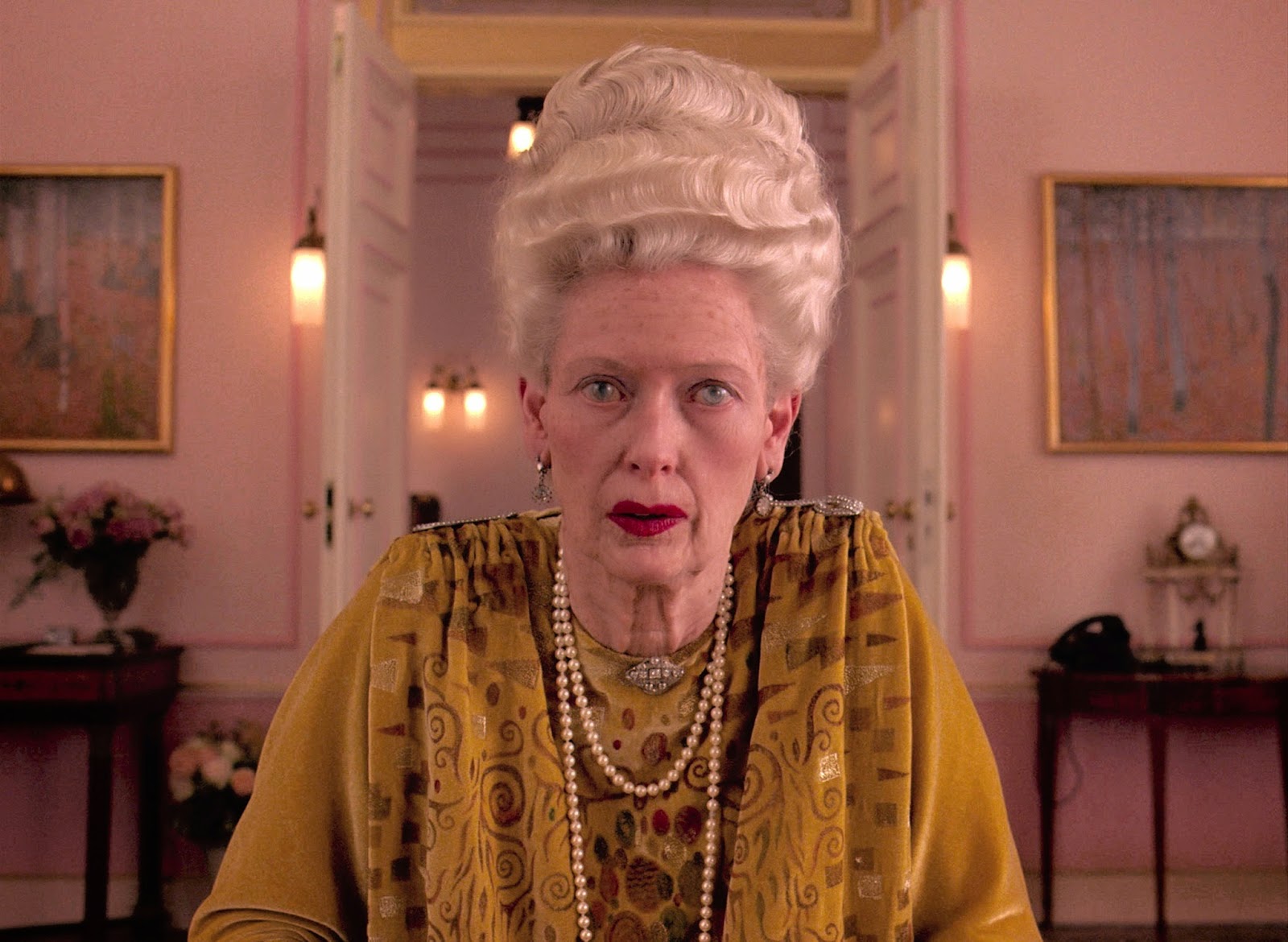
Madame D. (Tilda Swinton) in The Grand Budapest Hotel.
 
When Madame D. dies, there is a big gathering at her estate. In noble contrast to the leeches, liars and thieves present, M. Gustave and Zero are there, but they are not welcomed by the likes of Madame D’s sons, Dmitri (Adrien Brody) and Jopling (Willem Dafoe). When it is announced by the executor of the estate, Kovacs (Jeff Goldblum), that M. Gustave has inherited an extremely valuable gift, Dmitri and others conspire to destroy M. Gustave and get the valuable gift back.

The best film of Anderson’s film to date, The Grand Budapest Hotel is amusing and it looks spectacular – thanks to director of photography Robert Yeoman, production designer Adam Stockhausen, costume designer Milena Canonero and Frances Hannon, the hair, make-up and prosthetic designer. Sterile, worldly, ornate and whimsical like his other films, you got to hand it to Anderson, whatever his shortcomings are as a storyteller, he has a vision that is unique. Anderson has a distinct style.

The Grand Budapest Hotel is a fun film to watch; perhaps too fun. In his quest to recreate a nostalgic world, full of wonder and adorable characters, Anderson lacks the attack to go after bigger, more consequential ideals. While this is 1930s Eastern Europe, the Nazis are never mentioned by name. In another scene there is a shootout on a hotel floor; this could have been made into a satire on “stand your ground” and the expansion of concealed weapon laws in the U.S., but instead shoots itself into silliness. While in another scene, M. Gustave discusses the advantages of sex with older women, but the accompanying images are made for comical effect.

In addition to Abraham, Brody, Dafoe, Fiennes, Goldblum, Law, Swinton and Wilkinson, The Grand Budapest Hotel also features Mathieu Amalric as the important witness, Serge X,  Edward Norton as the nice "Nazi", Henckels, Saoirse Ronan as Zero's love interest, Agatha, Jason Schwartzman as B-rate concierge, M. Jean, and a funny Harvey Keitel as Ludwig, a shirtless prisoner with twitchy muscles.

It is an impressive cast, but the casting begins to wear out its welcome toward the end when Bill Murray (M. Ivan), Bob Balaban (M. Martin) and Owen Wilson (M. Chuck) and others appear to play throwaway bit parts. Anderson aficionados may find this clever – an inside joke, I suppose; I found it distracting, if not crass.

However, to the credit of Anderson and some casting director on the film (there are many casting directors credited in the film), the filmmakers cast newcomer Revolori to fill a big role while working along with some very accomplished actors. Fortunately, Revolori holds his own as the unlikely orphan-turned-loyal lobby boy who would one day own a hotel.

Zero (Tony Revolori) in The Grand Budapest Hotel.