Monday, 18 March 2013

SXSW 2013: A TEACHER

A scene from A Teacher.
Sex education

By Don Simpson

Diana (Lindsay Burdge) is a high school teacher who is clandestinely carrying out an affair with one of her students, Eric (Will Brittain). The two of them rarely converse, except for whenever they are coordinating their next meet up. Their relationship seems to be purely sexual and mutually consensual: an attractive teacher enjoys the energy and stamina of a teenage boy, while a teenage boy enjoys the maturity and experience of a teacher who is probably the subject of many of his classmates’ sexual fantasies.

Fully understanding the risks of having an affair with a student, Diana continues to do so as means of shirking her adult responsibilities. She has become purposefully estranged from her brother (Jonny Mars) in order to avoid having to take care of their sick mother. Diana’s relationship with Eric is a way for her to latch onto immaturity and youth. Despite her authoritative position at work, Diana enjoys playing a submissive role with Eric, dutifully obeying his commands like a well-trained pet.

Writer-director Hannah Fidell’s A Teacher maintains an extremely high level of suspense as Diana takes bigger and bigger chances in order to be with Eric. Brian McOmber’s masterfully atonal and percussive score escalates the film’s tension with its disturbing alternation between droning and piercing sounds; and it is not long before we realize that McOmber is forcing us inside of Diana’s crazed head-space. Andrew Droz Palermo’s cinematography is equally unnerving as it places us directly within the personal space of the characters. By always placing Diana within or nearby the camera’s frame, we experience the world of A Teacher from her intimate perspective. As Diana’s perception of reality becomes increasingly skewed and confined, so does our view of the onscreen events.

Fidell’s film commendably avoids explaining anything. Beginning and ending in medias res, we never truly grasp Diana and Eric’s motivations; and by honing in on the carnal desires of their present, Fidell cleverly negates the significance of Diana and Eric’s past and future.

Burdge proves herself to truly be a force to be reckoned with in this breakout performance. Not to discredit Will Brittain’s impressive performance, but the effectiveness of A Teacher rests heavily upon the shoulders of Burdge. With the aforementioned assistance of the cinematography and score, Burdge utilizes her eyes and body movements to reveal Diana’s vulnerability, naiveté and desperation. We may have seen stories like Diana’s before, but Fidell and Burdge present Diana from a uniquely feminine perspective. Diana is never a monstrous sexual predator; she is just someone who is just looking for love in a socially unacceptable place.

Thursday, 14 March 2013

THEATER REVIEW: THE FLYING DUTCHMAN

Tomas Tomasson in The Flying Dutchman.
Pop Cultured

By Ed Rampell

There is a popular misconception regarding so-called “high art,” like plays by Shakespeare and operas are elitist, only able to be fully understood and appreciated by the hoity-toity. But is this reputation deserved? What is Hamlet other than a revenge tale worthy of Quentin Tarantino and a ghost story? And what is Richard Wagner’s The Flying Dutchman (Der Fliegende Holländer) if not a rip roaring ghost story, highly charged by greed, and lest we forget, sexual frisson?

The composer adapted his 1843 opera from 17thcentury seafaring folklore, about a phantom ship roaming the high seas, never able to return to its home port. Only one thing can spare the ship’s captain -- the eponymous Dutchman (Icelandic baritone Tomas Tomasson) -- from his eternal nautical roaming: true love. Due to a storm off the coast of Norway the Dutchman encounters Daland (bass James Creswell), and they strike a sort of Faustian bargain: The Dutchman offers the Norwegian captain a treasure chest in exchange for his daughter’s hand in marriage.

Senta was to be played by Portuguese soprano Elisabete Matos, but according to L.A. Opera’s publicist, 12 minutes before the curtain was scheduled to rise on opening night, March 9, in a scene straight out of a 1930s Hollywood musical, Matos “had suddenly become indisposed, and would be unable to perform. Instead, soprano Julie Makerov would.

As the old saying puts it, “the show must go on!”, and boy, did it ever -- and marvelously so. Maerov flew right into The Flying Dutchman. Fortunately, according to her website bio, Makerov had previously played Senta at Canada and Salzburg, and she performed peerlessly at the premiere. Makerov brought the wronged Senta vividly to life with song and acting, as she tried to defend her honor and purity to two suitors: The Dutchman and the hunter Erik (American tenor Corey Bix). Senta’s sonorous, spirited self defense might even make a Shakespeare write “methinks the lady doth not protest too much.” Whether singing “Senta’s Ballad” or the famous duet with the nautical specter she is betrothed to, Makerov admirably rose to the occasion -- especially given her 12-minute notice to report for duty aboard the HMS Chandler.

The sets by Bavarian scenery designer Raimund Bauer, costumes by his fellow German Andrea Schmidt-Futterer and lighting design by Duane Schuler, strike the right imaginative, eerie chords in expressing this shadowy, supernatural saga. During the emotion laden 10-minute overture, a scrim of surging seas is accompanied by music that could best be called “Wagnerian,” conveying a sense of turbulent, crashing waves. Act I transports us out to sea aboard creatively evoked ships near a Norwegian harbor. Later in this three-acter the entire ensemble gathers at Daland’s Scandinavian village, and the mass mise-en-scene is quite impressive and at times appropriately ghoulish. During these scenes the work of choreographer Denni Sayers -- with some balletic moves -- and chorus director Grant Gershon especially shine.

As well it should be, the production is quite Germanic -- Schmidt-Futterer’s costumes are at times extremely suggestive of German silent cinema’s Expressionism, with period apparel reminiscent of the demonic title character of The Cabinet of Dr. Caligari and F.W. Murnau’s telling of the Dracula fable, Nosferatu. In other scenes the costuming reminded me of L.A. Opera’s highly stylized re-telling of Wagner’s Ring Cycle a few seasons back, with its pseudo-Star Wars panache.

And what of The Flying Dutchman’s music and of the librettist and composer, who about 30 years later would complete The Ring of the Nibelungen? The Flying Dutchman’s theme of exile would psychologically appeal to Wagner -- not only because he was a globetrotter himself, but in only five or so years after presenting The Flying Dutchmanhe would himself become a stateless wanderer due to his taking part in Europe’s 1848 workers revolution. Wagner was forced to flee Germany and live abroad in Switzerland for around 12 years. Like the Dutchman, Wagner would be “banished from his homeland.” The phantom mariner was the first of Wagner’s exile characters, and on a metaphorical, metaphysical level one can perceive that this genius would identify with the outcast. Wagner knew what it felt like to be a persona non grata. And given his tumultuous private life Wagner could presumably relate to the turmoil of the relationship between the Dutchman, Senta and Erik -- a rather messy ménage-a-trois, if ever there was one, with that fourth partner named “fate.”

The sonorous score, deftly conducted by James Conlon, is full of Wagner’s hallmark sonic sturm und drang: brassy refrains, drums, dramatic outbursts and the like, which some might consider to be bombastic. But the earnest music also conveys a powerful, transcendent sense of yearning and longing -- to belong, be loved and for home.

Please note: The two and a half hour-plus opera is performed sans intermission.


The Flying Dutchman runs through March 30 at L.A. Opera at the Dorothy Chandler Pavilion, 135 N. Grand Ave. For more info: 213-972-8001; www.laopera.com.


Tuesday, 12 February 2013

SFF INDIEFEST 2013: BERBERIAN SOUND STUDIO

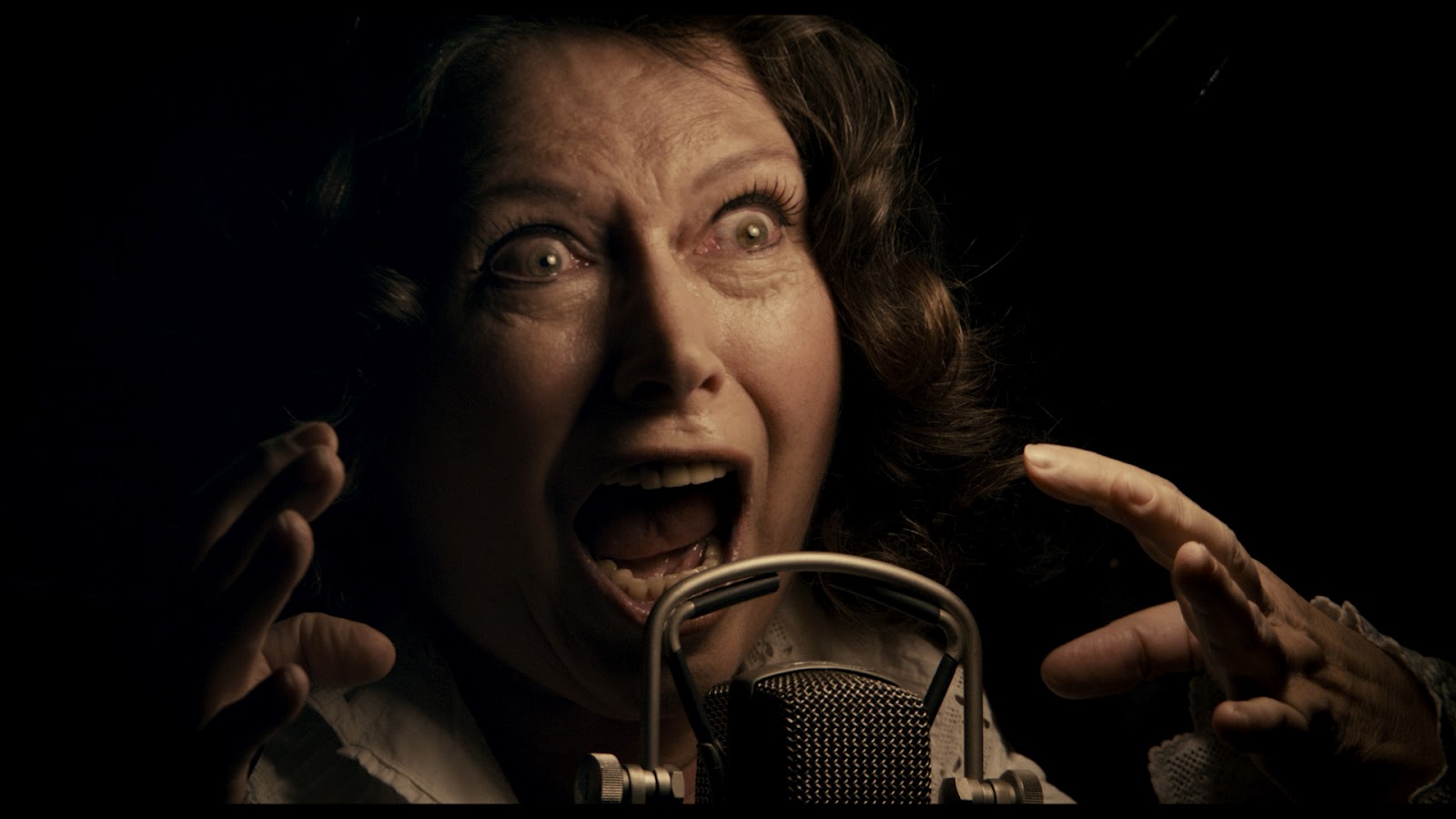
A scene from Berberian Sound Studio.
Giallo figura magnifico

By Don Simpson

An extremely shy Englishman, Gilderoy (Toby Jones) has just arrived in Italy to essentially become a one-man sound team for The Equestrian Vortex, the latest film by Italian giallo maestro Santini (Antonio Mancino). Up until now, Gilderoy has only worked on English documentaries and children's programs; so Gilderoy approaches his surreal new position like a frightened mouse (an analogy that is visually hinted upon by the juxtaposition of Jones' height with his taller Italian counterparts). A foreigner in many senses of the word, Gilderoy's naiveté is showcased by his lack of understanding of the Italian language as well as his obliviousness to the cinematic language of the giallo genre. What Gilderoy does understand is sound recording, so as long as the perpetually angry Francesco (Cosimo Fusco) agrees to speak English to him, Gilderoy can timidly proceed with the task at hand. From here on out, Gilderoy devotes everything to his work in a fruitless attempt to forget about his homesickness.

As time wears on, Gilderoy’s constant exposure to extreme cinematic violence gnaws away at his psyche until he becomes fully immersed in the graphic images of the film. Berberian Sound Studiowriter-director Peter Strickland cleverly ensures that we never see a single frame from The Equestrian Vortex -- other than the masterful title sequence designed by Julian House; we only ever hear brief audio descriptions of the on-screen scenarios and the over-dubbed dialogue and Foley sounds. This is a purposeful, and effective, statement by Strickland to stress the significance of sound in the giallo genre. With all of the sound recorded in post-production, this creates a very literal disconnection between the sound and image. The deconstruction of the signature giallo sounds is what Strickland cares about the most. For example, in a few absurdly comedic asides, Strickland shows Foley artists re-creating the spine-tingling sounds of stabs, slashes, squashes and splats with a produce market's variety of fruit and vegetables. (Oh, yes, Gallagher would most certainly be proud of these sound artisans!)

While the confoundingly subdued Berberian Sound Studio refuses to deliver much in the way of thrills or chills, it does offer a very poignant critique of the Italian giallo film industry. This is a film about the exploitation of actors and crew -- by directors and producers who wholeheartedly believe that the privilege of working on such fine pieces of cinematic “art” legitimize their sexual (and psychological) harassment -- as well as the stingy bureaucracy of low budget film productions. Strickland's film also embellishes upon the cultural and societal differences between machismo Italian men and navel-gazing Englishmen, because nobody else accepts this potent brand of psychological torture like a stuffy Englishman.


Monday, 11 February 2013

SF INDIEFEST 2013: THE INTERNATIONAL SIGN OF CHOKING

A scene from The International Sign of Choking.
The Other opportunities
 
By Don Simpson
 
While Josh (Zach Weintraub) has presumably traveled to Buenos Aires to shoot an undefined video project, he seems much more interested in tracking down a woman named Martina. From what we can piece together, Josh has been to Buenos Aires at least once before and Martina is a woman with whom he enjoyed a fling or a crush or something. Then again, the past does not matter nearly as much as the present, which is essentially a collection of Josh’s failed attempts at tracking down Martina.
 
Enter Anna (Sophia Takal), another United States citizen who is staying in the same boarding house as Josh. Anna is not nearly as fluent in Spanish as Josh, thus establishing him as her a de facto translator. They begin to hang out more and more, but then Josh gets weird and pushes Anna away. It is incredibly fascinating to observe Josh’s on-again-off-again feelings towards Anna and how his wishy-washy, nonchalant attitude and overall indifference visibly makes Anna frustrated and upset. And who could blame her? Josh seems to be purposefully torturing Anna (as a consequence of his inability to track down Martina?), using her to quench his loneliness with sex one minute and pushing her away the next.
 
As a film that is essentially about the disassociation and loneliness of traveling alone to a foreign country, Weintraub’s The International Sign for Choking shows the passing-like-ships-in-the-night relationships that seem to go hand-in-hand with solo international treks. Foreign travel is often romanticized as an opportunity to enjoy love without attachment, but what happens when one is prone to becoming attached? We have no idea what Josh and Martina’s relationship was like, or how long ago it occurred, but it is fairly likely that it was similar to his relationship with Anna. Maybe Josh did not realize he liked Martina until after he left Buenos Aires, and by then it was too late? In which case, will he feel the same way about Anna in a few months (or years)? Will Anna be yet another missed opportunity, another woman whom Josh let slip through his fingers?
 
Weintraub creates two protagonists who are not typical American tourists — the kind that locals probably disdain (Josh and Anna meet some of those very types of tourists one night in a bar); instead, Josh and Anna strive to immerse themselves in Argentine culture, closely observing Argentine habits and idiosyncrasies. So, on one level, Josh might be an ideal tourist but, as far as relationships go, his inability to establish lasting connections is far from idealized.

Friday, 8 February 2013

FILM REVIEW: IDENTITY THIEF

Diana (Jenny McCarthy) in Identity Thief.
Stolen vices

By Ed Rampell

The odiously unfunny Identity Thief is the latest installment in the “women behaving badly” cycle that has included the far funnier Bridesmaids and even Bad Teacher. Although for some reason the bland Jason Bateman gets top credit over Melissa McCarthy, who was Oscar nominated for the former, she stars as Diana in this flick that’s about as funny as McCarthyism. Diana (or whatever her name really is) assumes the name and identity of Sandy Bigelow Patterson (Bateman) and proceeds to live high off the hog, literally at his unwitting, unwilling expense.

Identity theft is a serious issue, but what the screenwriters Craig Mazen (who’s apparently extremely versatile, as the amazing Mazen also has credits for writing men behaving badly pix, including The Hangover II and III) and Jerry Eeten seem to have done is take a topical trendy subject that has a certain cachet and “brand name” appeal in order to attract attention to a movie that really deals with the title only about five percent or so of the time. The rest of the film is more of a road trip (but with On the Road and the upcoming Big Sur, I guess Jack Kerouac has that move market cornered) about the overweight 40-something McCarthy’s vulgar hijinks. We’re supposed to find sheer hilarity in a fat middle-aged woman’s masturbating, having sex, meting out and receiving physical punishment and, but of course, the McCarthy house specialty: foul mouthing.

But I was unamused and judging by the response of the Arclight audience, which -- like your beleaguered critic who puts himself into harm’s way by reviewing where fools fear to tread so you, dear viewer, don’t have to -- only laughed intermittently, so will the average moviegoer. This pic reminded me of Roseanne Barr’s unfortunate 1989 She-Devil, which she subsequently denounced. It is a sign of the appallingly low level of social discourse in an America in decline that the “women behaving badly” cycle is some sort of indication and even example of female empowerment. It’s like the “liberals” who believe that allowing women, gays and undocumented immigrants to fight for the U.S. military in combat is likewise some sort of manifestation of “equal rights.” Yes, you too can get your limbs blown off, have lifelong PTSD, even get killed, commit war crimes and atrocities invading Third World countries that never attacked us, by fighting for U.S. imperialism! Because we’re all equal pawns and cannon fodder now for the American Empire. In a similar way, “women behaving badly” poses the notion that “equality” means females adapting the same type of aggressive, belligerent, obnoxious behavior that is widespread among rude, crude dudes in our increasingly impolite, alienated society. (See Amy Alkon’s book, I See Rude People.)

Jon Favreau, John Cho and Amanda Peet are wasted in bit parts in Identity Thief. Modern Family’s Eric Stonestreet, however, is droll as Big Chuck in a sex scene that plays against type.

The most trenchant observation Identity Thief makes is that when the completely innocent Sandy encounters the police (Morris Chestnut is serviceable as Detective Reilly) regarding the theft of his identity resulting in thousands of dollars of overcharges he did not make, the pigs are completely unwilling and unable to help him. How typical: As Alfred Hitchcock shrewdly observed (and there’s a sequence in Psycho that specifically deals with this idea), the police are usually completely ineffectual. (Except when you go out on strike or protest or occupy -- then, but of course, they’re always there to beat you upside the head with their billy clubs, mace you, chase you or even worse.)

But the main thing that this ugly flick directed by Seth Gordon will steal is your time and money wasted purchasing tickets to see this unfunny waste of time.


Wednesday, 6 February 2013

SF INDIEFEST 2013: SIGHTSEERS

Tina (Alice Lowe) in Sightseers.
Edgy comedy

By Don Simpson

Chris (Steve Oram) and Tina (Alice Lowe) have only been dating for a few months when Chris suggests that they drive across the rolling countryside of Britain for a week-long vacation. Chris wants to show Tina his “world,” which basically means taking her to various sites of historical significance that he holds dear to his heart. The trip will also whisk Tina away from her emotionally manipulative mother (Eileen Davies), who has kept Tina from doing much of anything with her life.

It is not long after they hitch up Chris’ Abbey Oxford Caravan and hit the road that their getaway takes on other connotations. It quickly becomes apparent that Chris has anger management issues, and Tina’s mental state is no less fragile. The claustrophobic space inside the caravan serves as a boiling pot for their emotions; either one of them can snap at any time.

Ben Wheatley’s Sightseershumorously observes masculine and feminine aggression, sticking with (and possibly satirizing) the gender stereotypes of men being overly-methodical and women being overly-emotional. Violence for each of the characters is triggered and unleashed much differently, and they both rationalize their violent acts in different ways as well. Whether it is purposeful or not, Wheatley’s film becomes an intriguing -- and comical -- social commentary on aggression; yet, simultaneously, the violence is totally rationalized by the characters’ irrationality. So by making the characters “crazy,” this differentiates them from “normal” society and fully explains their abnormal behavior. That, of course, also makes the violence much easier for us — the audience — to laugh at without any pesky moral dilemmas to burden us with guilt.

Saturday, 2 February 2013

DANCE REVIEW: RITE OF SPRING

A scene from Joffrey Ballet's Rite of Spring.
Without weapons

By Ed Rampell

L.A.’s Music Center is celebrating the 100thanniversary of Le Sacre du Printemps (The Rite of Spring) with performances of the work that rocked the classical dance world’s sense of decorum with a rendition by the renowned Joffrey Ballet that strives to reconstruct its May 29, 1913 contentious premiere at the Theatre des Champs-Elysees. That dazzling debut danced by Sergei Diaghilev’s Ballet Russes -- with music by Igor Stravinsky, choreography by Vaslav Nijinsky, scenario and designs by Nicholas Roerich -- rather infamously made a bewildered Parisian audience go wild in the seats, with a near riot and firing of apocryphal gunshots. After only a handful of performances, the controversial production was shutdown, and Le Sacre du Printemps was rarely presented as first seen and heard until the Joffrey’s 1987 reconstruction of the original.

The good news is that while the Angelenos filling the Dorothy Chandler Pavilion did not appear to be pistol-packing, Le Sacre du Printemps still packs a punch a century later. And while the seats might have been sold out, the creators’ artistic vision, which the Joffrey endeavors to faithfully recreate here, has not been sold out. With its primordial strong sexual undertones the story which the quartet (if you include Diaghilev) of collaborators sought to tell is suggested by the mythology and primitive pagan past of the fearsome foursome’s native Russia. In essence, it is the expression of an ancestral ancient fertility ritual and sacrificial offering through sound and sight, the latter in terms of choreography, costuming and painted backdrops. The finale hints at what may be a gang rape.

The ballet opens with the plaintive plea of a bassoon, but this serene solo swiftly explodes in Stravinsky’s score, which has more bars than Dublin. More woodwinds and strings join in, followed by brass and percussion as what appears to be shepherds, farmers, hunters and gatherers in a rural setting garbed in toga, Roman sandals, colorful peasant blouses and harlequin type costumes engage in a sort of convocation of the tribes. Together they dance the Augurs of Spring, expressing their adoration of the fertile, life-giving soil, giving thanks to Yarilo, the Slavic sun god of legend. As the 1913 program put it, “Everyone tramples the Earth with ecstasy.” Indeed.

As the often dissonant music builds, Nijinsky’s choreography ranges from the sublime to stamping and stomping, from the harmonious to the herky-jerky. In Act II, The Sacrifice, the menacing music, with much pounding of the sharkskins and trumpet blaring, almost seems to be announcing that the Polynesian Luana is going to be tossed into a volcano a la Bird of Paradise or that King Kong enters stage left. Indeed, in the second act, like those filmic vestal virgins Dolores del Rio or Fay Wray, a maiden (and presumably her maidenhead) is sacrificed to the heathen god, as she literally dances herself to death.

At least three of Roerich’s pastoral backdrops are reproduced here. All seemed to my eye to be in the Fauvist mode then in vogue with the European avant-garde, as typified by Henri Matisse. But Roerich’s expressionistic, mural-size paintings are far less joyous than Matisse’s canvases, and in all of them cumulus clouds gather ominously. Jack Mehler’s subtle lighting (after Thomas Skelton) changes the coloring of the clouds which, like the Joffrey’s whirling dervishes, are aswirl. This version’s costumes and decors are after Roerich, with scenic supervision and costumes executed by Robert Perdiola and Sally Ann Parsons.

The ballet’s heady mix of sex and violence can still cause 2013 spectators, like their Parisian forebears in 1913, to exclaim “Sacre bleu!” at Le Sacre du Printemps. (Indeed, a recent acid attack on the Bolshoi’s artistic director has caused the company’s 100th anniversary performances of the ballet to be postponed. Apparently some still regard The Rite to be a bad acid trip.)

Interestingly, however, the sacred Le Sacre du Printemps didn’t score the evening’s biggest standing ovation. Also on the program preceding it were the ballets Age of Innocence, In the Middle, Somewhat Elevated and After the Rain. It was the second part of the latter which had the Chandler’s denizens leap to their feet hurling kudos and “bravos” at the male and female duet who tenderly danced a pas de deux containing more sensuousness and passion than any porn flick. With her exquisite extensions, if not precisely prim and proper, the pink leotard clad dancer put the prima into ballerina. She and her bare-chested partner danced to Spiegel im Spiegel, with the breathtakingly executed choreographed lovemaking wrought by Christopher Wheeldon and music composed by Estonian Arvo Pärt.

The Music Center’s presentation of The Rite of Spring launches L.A.’s Rite: Stravinsky, Innovation and Dance, a festival honoring the composer who became an émigré here in the City of the Angels during WWII. The festival will include the participation of longtime L.A. Phil conductor Esa-Pekka Salonen and intermittently take place through October 2013, the centennial year of Stravinsky’s most influential -- if only rarely glimpsed in its original sound and fury -- work. All one can say is: Rite on! All power to the ballerinas!  


Le Sacre du Printemps (The Rite of Spring) runs tonight, 7:30 p.m.; Feb. 3 at 2:00 p.m.  at the Dorothy Chandler Pavilion, 135 N. Grand Ave. For more info: (213)972-8555; www.musiccenter.org